Today's
EarthStation1.com 15% (Or More!) Off Commemorative Memorial Title:
September 11th Attacks MP3s, MPGs & JPGs CD, Download, USB
Flash Drive
Today, September 11, 2026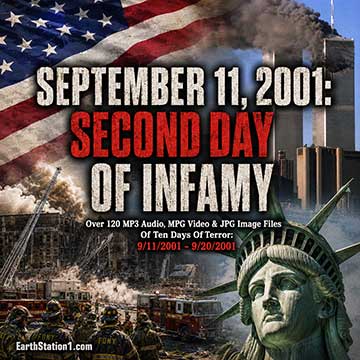
September 11, 2001: Patriot Day: --
September 11 National Day Of Service And Remembrance (9/11 Day):
September 11 Attacks occur, killing 2,997 people, injuring over
6,000 others, causing at least 10B USD in infrastructure and
property damage, and altering as a result the course of American
and world history. Patriot Day occurs on September 11 of each year
in the US in memory of the people killed in the September 11
Attacks. The September 11 National Day Of Service And Remembrance
or 9/11 Day is a federally-recognized day of unity and charitable
service, annually observed throughout the United States and in
other countries around the world. It was a terrifying day when
four planes were hijacked on September 11, 2001 (also known as
nine-eleven). The hijackers flew three planes into iconic
buildings: the Pentagon in Washington DC and the Twin Towers of
the World Trade Center in New York. The fourth plane crashed in a
field in Pennsylvania after the plane passengers fought the
hijackers. Nobody is certain where it was supposed to crash, but
some people believe it was headed for the White House, the U.S.
Capitol, the Camp David presidential retreat in Maryland, or one
of several nuclear power plants along the eastern seaboard. The
impact of this attack was devastating. Around 3,000 lives were
lost between plane passengers, those in the buildings that were
struck, and front-line workers trying to save people. It was the
biggest act of terrorism ever in the United States. Since then,
airplane security has become stricter in many countries as they
attempt to avoid a future terrorist attack like nine-eleven. The
majority of lives that were people that worked in the Twin Towers,
especially the floors above the collision point as people were
trapped and stranded at the top of the burning skyscraper. 411 men
and women working in emergency services lost their lives trying to
fight fires and rescue people from the buildings. It was a
heartbreaking attack, which is why Patriot Day was proclaimed by
President George W. Bush and is recognized every year on September
11. On Patriot Day, U.S. flags are lowered halfway, and there is a
country-wide moment of silence at 8:46 am (Eastern Daylight Time),
which is when the first plane crashed into one of the Twin Towers.
Although the attacks were in the U.S., Patriot Day is recognized
worldwide as the news devastated and impacted people all over. On
Sale Until Midnight Tonight PT!
https://store.earthstation1.com/september-11th-attacks-mp3s-mpgs-jpgs-cd-usb-dr113.html
Today's
EarthStation1.com 15% (Or More!) Off Commemorative Memorial Title:
John F. Kennedy: Years Of Lightning, Day Of Drums DVD, Download,
USB
Today, September 11, 2026
September 11 National Day Of Service: --
Of course, it is right to grieve and remember the events that took
place on this day in 2001, but an equal hope behind the day is
that it can be redeemed - so that the terrorists do not have the
last word and this instead becomes a day of unity and service.
Millions of Americans participate in different activities, events,
and ceremonies each year to honor this remembrance and service
event. The hope is that the people of the US, and perhaps even
around the world, will turn this day from one of tragedy into one
that offers an opportunity for doing good. This event goes along
with what some people celebrate in the US as Patriot Day, which
was declared by President George W. Bush in 2002. Later, the
September 11 National Day of Service and Remembrance became
federally recognized by the US government as part of the Edward M.
Kennedy Serve America Act, which was adopted in 2009 and also
includes Martin Luther King Jr. Day. It was also during that year
President Barack Obama made this day official with a presidential
proclamation. As President John F. Kennedy, founder of the
international service organization The Peace Corps said at his
inauguration as president: "Ask not what your country can do
for you - ask what you can do for your country." On Sale
Until Midnight Tonight PT!
https://store.earthstation1.com/john-f-kennedy-years-of-lightning-day-of-drums-dvd.html
Today's
EarthStation1.com 15% (Or More!) Off Commemorative Memorial Title:
The Temple In Jerusalem & The Ark Of The Covenant MP4 Download
DVD
Today, September 11, 2026
Shana Tova! And a Happy Jewish New Year to all! ========= September 11-13, 2026: Rosh Hashanah, literally meaning the "head the year", the Jewish New Year, begins at sundown September 11, 2026, lasts all day on September 12, 2026 and ends at sundown on September 13, 2026. The biblical name for this holiday is Yom Teruah, literally "day of shouting or blasting". It is the first of the Jewish High Holy Days (Yamim Nora'im. "Days of Awe") specified by Leviticus 23:23-32 that occur in the early autumn of the Northern Hemisphere. Rosh Hashanah is a two-day celebration that begins on the first day of Tishrei, which is the seventh month of the ecclesiastical year. In contrast to the ecclesiastical year, where the first month Nisan, the Passover month, marks Israel's exodus from Egypt, Rosh Hashanah marks the beginning of the civil year, according to the teachings of Judaism, and is the traditional anniversary of the creation of Adam and Eve, the first man and woman according to the Hebrew Bible, and the inauguration of humanity's role in God's world. According to one secular opinion, the holiday owes its timing to the beginning of the economic year in Southwest Asia and Northeast Africa, marking the start of the agricultural cycle. Rosh Hashanah customs include sounding the shofar (a cleaned-out ram's horn), as prescribed in the Torah, following the prescription of the Hebrew Bible to "raise a noise" on Yom Teruah. Its rabbinical customs include attending synagogue services and reciting special liturgy about teshuva, as well as enjoying festive meals. Eating symbolic foods is now a tradition, such as apples dipped in honey, hoping to evoke a sweet new year. #RoshHashanah #JewishNewYear #TomTeuah #YamimNoraim #ShanaTova #MP4 #VideoDownload #DVD On Sale Until Midnight Tonight PT! https://store.earthstation1.com/teinjearkofc.html
EarthStation1.com
15% (Or More!) Off Commemorative Memorial Title: Washington, D.C.
History Video Set DVD, MP4 Download, USB Flash Drive
Today, September 11, 2026
September 11: Libraries Remember Day: --
Acknowledges the role of public libraries in social welfare. A
public library is a place of learning where anyone can become a
member by paying a small fee. Libraries allow us to access
information online, read and discover books, take notes, and form
communities that are centered around learning and knowing.
Libraries are a storehouse of knowledge and they support equal
learning opportunities for everyone despite their age or
background. Libraries also play a crucial role in cultivating the
habit of reading and seeking answers to what we don't know. After
the ghastly attacks on the Twin Towers on September 9, 2001, there
were talks on its tenth anniversary regarding how to remember the
victims and honor their memory. It seemed obvious that the most
fitting memorial would be to build a public library on the site of
what was the World Trade Center. Libraries represent knowledge and
equal access to that knowledge. They also stand for freedom of
expression, a celebration of diversity, preservation of heritage,
and hope for the future. A library represents everything that
stands firmly against terrorism, hatred, bigotry, and fanaticism.
Thus, it was decided that on September 11, America will celebrate
its public libraries. Libraries have been a part of our social
structure since the earliest times. The first library dates back
to 2600 BC. Since then every important civilization has kept a
track of its history in archives, which were kept in the
libraries. The libraries of powerful emperors and rulers have
given us some of the most celebrated works of literature.
Libraries Remember Day is celebrated by facilitating
communication, fostering citizenship, promoting understanding,
guaranteeing freedom of access to information, and welcoming
everyone to the libraries as a symbol of freedom and fearlessness.
In commemoration of the victims of the September 11, 2001 tragedy,
Libraries Remember Day celebrates the role public libraries play
in the preservation of a free society. Many public libraries
across America remain open for the entire 24 hours on this day -
the day starts at midnight and closes on the next midnight.
Throughout the day, activities, remembrances, and performances
take place at the libraries. On Sale Until Midnight Tonight PT!
https://store.earthstation1.com/washington-dc-history-videos-dvd-mp4-download-usb-driv4.html
Today's
EarthStation1.com 15% (Or More!) Off Commemorative Memorial Title:
New York City History Documentary Collection MP4 Video Download
DVD
Today, September 11, 2026
September 11, 1609: The Colonial History
Of The United States: Dutch Colonization Of The Americas: New
Netherland (Dutch: Nieuw Nederland, Latin: Novum Belgium): The
History Of New York City: The Expeditions Of Henry Hudson: The
Expedition Of 1609: The Voyage Of The Halve Maen (Dutch: "Half
Moon"): Henry Hudson's Discovery Of The Island Of Manhattan:
-- Henry Hudson arrives at Manhattan Island and meets the
indigenous Munsee Lenape Native Americans living there. He was not
the first documented European to have visited the area. In 1524,
Florentine explorer Giovanni da Verrazzano, sailing in service of
King Francis I of France, became the first European to visit what
would become New York City. He entered the tidal strait now known
as The Narrows and named the land around Upper New York Harbor New
Angouleme, in reference to the family name of King Francis I that
was derived from Angouleme in France; he sailed far enough into
the harbor to sight the Hudson River, which he referred to in his
report to the French king as a "very big river"; and he
named the Bay of Santa Margarita - what is now Upper New York Bay
- after Marguerite de Navarre, the elder sister of the king.
However, it was not until the voyage of Henry Hudson, an
Englishman who worked for the Dutch East India Company, that the
area was mapped. Hudson came across Manhattan Island and the
native people living there, and also continued up the river that
would later bear his name, the Hudson River, until he arrived at
the site of present-day Albany. The name Manhattan derives from
the Munsee Lenape language term manahahtaan (where manah- means
"gather", -aht- means "bow", and -aan is an
abstract element used to form verb stems). The Lenape word has
been translated as "the place where we get bows" or
"place for gathering the (wood to make) bows". According
to a Munsee tradition recorded in the 19th century, the island was
named so for a grove of hickory trees at the lower end that was
considered ideal for the making of bows. It was first recorded in
writing as Manna-hata, in the 1609 logbook of Robert Juet, an
officer on Henry Hudson's yacht Halve Maen (Half Moon). A 1610 map
depicts the name as Manna-hata, twice, on both the west and east
sides of the Mauritius River (later named the Hudson River).
Alternative folk etymologies include "island of many hills",
"the island where we all became intoxicated" and simply
"island", as well as a phrase descriptive of the
whirlpool at Hell Gate. On the soil retaining wall of G. Thomas
DiDomenico 16th Street Park in Bayonne, New Jersey facing Newark
Bay, there is a mural which depicts the Halve Maen due to
Bayonne's location across the Hudson River from Battery Park, at
the southern tip of Manhattan near the mouth of the river, by
which Henry Hudson sailed. #HenryHudson #Manhattan
#IslandOfManhattan #Munsee #Lenape #NativeAmericans #MP4
#VideoDownload #DVD On Sale Until Midnight Tonight PT!
https://store.earthstation1.com/new-york-city-history-videos-3-dvd-se3.html
Today's
EarthStation1.com 15% (Or More!) Off Commemorative Memorial Title:
Franklin D. Roosevelt Speeches DVD, MP3 Download, USB Flash Drive
Today, September 11, 2026
September 11, 1941: The European Civil
War: World War II: The Second European War (The European Theater
Of World War II): The Battle Of The Atlantic: The Greer Incident:
-- Franklin Delano Roosevelt delivers his Fireside Chat 18: On The
Greer Incident, also known as the Shoot On Sight Speech, regarding
the Sept. 4, 1941 combat engagement between the destroyer USS
Grier and the German submarine U-652: "The Greer was flying
the American flag. Her identity as an American ship was
unmistakable. She was then and there attacked by a submarine.
Germany admits that it was a German submarine. The submarine
deliberately fired a torpedo at the Greer, followed by another
torpedo attack. In spite of what Hitler's propaganda bureau has
invented, and in spite of what any American obstructionist
organisation may prefer to believe, I tell you the blunt fact that
the German submarine fired first upon this American destroyer
without warning, and with the deliberate design to sink her.".
The Greer Incident occured on September 4, 1941 when the US Navy
destroyer USS Greer aggressively patroled over the known position
of a German U-Boat submarine, and by the Greer's provocative use
of its sonar equipment to send the message that the US ship might
be about to conduct a depth charge attack, it goaded the U-Boat
(later identified as U-652) to fire two torpedoes upon the Greer,
neither of which made contact. This provocation was in keeping
with an off-the-record promise Franklin D. Roosevelt made to
Winston Churchil during The Atlantic Charter Conference held three
weeks prior to the attack that there would be "an incident"
in the Atlantic between the United States and Germany before the
end of 1941. On Sale Until Midnight Tonight PT!
https://store.earthstation1.com/franklin-roosevelt-mp3-dvd-fireside-chats-and-wwii-radi3.html
Today's
EarthStation1.com 15% (Or More!) Off Commemorative Memorial Title:
Lindbergh: Biography Of Charles Lindbergh Documentary DVD, MP4,
USB
Today, September 11, 2026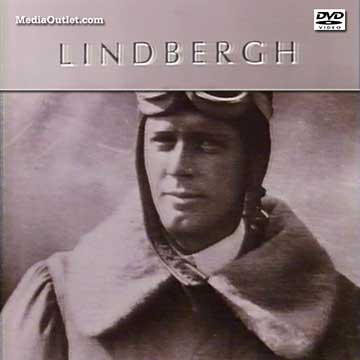
September 11, 1941: The Interwar Period
(The Interbellum, Between The Wars): Isolationism
(Non-Interventionism): United States Isolationism (United States
Non-Interventionism): The Road To War: The America First Committee
(AFC): Charles Lindbergh's "Who Are the War Agitators?"
Speech (Charles Lindbergh's Des Moines Speech): -- One of the
vilest foreign policy speeches ever given by a prominent American
is delivered by Charles Lindbergh, accusing the British, Jews and
FDR's administration of pressing for war with Germany; Germany
would declare war on the United States three months later. Though
he was among America's greatest heroes, having been the first
person to fly solo across the Atlantic, he had become the face of
the noninterventionist movement in the United States on the eve of
America's involvment in World War II. In the words of historian
Wayne Cole, "no other noninterventionist speaker aroused such
enthusiastic support" as Lindbergh. In his speeches during
the first two years after Poland fell, Lindbergh had implied that
"powerful elements" were pushing the United States into
war. But he had always stopped short of saying who he thought
those elements were. As he took the stage before 8,000 Iowans in
the Des Moines Coliseum in September 1941, however, he wanted to
name names. Calling his speech "Who Are the War Agitators?,"
Lindbergh claimed that "The three most important groups who
have been pressing this country toward war are the British, the
Jewish and the Roosevelt administration." He went on to
analyze what he saw as each group's motives, saying of "the
Jewish" in particular: "It is not difficult to
understand why Jewish people desire the overthrow of Nazi Germany.
The persecution they suffered in Germany would be sufficient to
make bitter enemies of any race. No person with a sense of the
dignity of mankind can condone the persecution of the Jewish race
in Germany. But no person of honesty and vision can look on their
pro-war policy here today without seeing the dangers involved in
such a policy both for us and for them. Instead of agitating for
war, the Jewish groups in this country should be opposing it in
every possible way for they will be among the first to feel its
consequences. Tolerance is a virtue that depends upon peace and
strength. History shows that it cannot survive war and
devastation. A few far-sighted Jewish people realize this and
stand opposed to intervention. But the majority still do not.
Their greatest danger to this country lies in their large
ownership and influence in our motion pictures, our press, our
radio and our government." Hitler declared war on the United
States on December 10, 1941, three days after the Japanese
attacked Pearl Harbor, and three months after this speech. On Sale
Until Midnight Tonight PT!
https://store.earthstation1.com/lindbergh-1990-dvd-biography-documen1990.html
Today's
EarthStation1.com 15% (Or More!) Off Commemorative Memorial Title:
The Battle Of Germany & Fall Of The Third Reich DVD Download
USB Drive
Today, September 11, 2026
September 11, 1944: The European Civil
War: World War II: The Second European War (The European Theater
Of World War II): The Western Front Of World War II: The Siegfried
Line Campaign (The Pursuit To The Rhine, The Allied Advance From
Paris To The Rhine, The Liberation Of Western Europe): The Western
Allied Invasion Of Germany: The Battle Of Aachen: The First Battle
Of Aachen: -- The Western Allied Invasion of Germany begins as
Americans clash with German forces in and around Aachen. The First
Battle of Aachen is distinguished from the larger Battle of Aachen
that took place between October 2-21, 1944 in the same area
involving the same forces. The city had been incorporated into the
Siegfried Line, the main defensive network on Germany's western
border; the Allies had hoped to capture it quickly and advance
into the industrialized Ruhr Basin. The city was defended by the
116th Panzer Division, under the command of General Gerhard von
Schwerin. The proximity of Allied forces had caused the majority
of the city's government officials to flee before the evacuation
of its citizens was complete (For this, Hitler had all Nazi
officials who had fled stripped of rank and sent to the Eastern
front as privates). Instead of continuing the evacuation, von
Schwerin opted to surrender the city to Allied forces; however, on
13 September, before he could deliver a letter of capitulation he
had written, von Schwerin was ordered to launch a counterattack
against American forces penetrating southwest of Aachen, which he
did, using elements of his panzergrenadier forces. The German
general's attempt to surrender the city would soon become
irrelevant, as his letter was never delivered; instead, it fell
into the hands of Adolf Hitler, who ordered the general's
immediate arrest. He was replaced by Colonel Gerhard Wilck. The
United States' VII Corps continued to probe German defenses,
despite the resistance encountered on 12-13 September. Between
14-16 September the US 1st Infantry Division continued its advance
in the face of strong defenses and repeated counterattacks,
ultimately creating a half-moon arc around the city. This slow
advance came to a halt in late September, due to the supply
problem, and the diversion of existing stocks of fuel and
ammunition for Operation Market Garden in the Netherlands.
Ultimately, Aachen was the first city on German soil to be
captured by the Allies. On Sale Until Midnight Tonight PT!
https://store.earthstation1.com/the-battle-of-germany-amp-fall-of-the-third-reich-dvd-download-usb-drive.html
Today's
EarthStation1.com 15% (Or More!) Off Commemorative Memorial Title:
Auschwitz And The Allies 2 Part TV Series DVD, Download, USB Drive
Today, September 11, 2026
September 11, 1924: #BOTD: #HBD! Rudolf
Vrba (Rudolf Urba), Czech Slovak-Jewish Canadian pharmacologist,
educator, holocaust victim who became known for his daring escapee
from Auschwitz-Birkenau concentration camp in April 1944, at the
height of the Holocaust, and for having co-written a detailed
report about the mass murder that was taking place there, which
having been distributed by George Mantello in Switzerland is
credited with having halted the mass deportation of Hungary's Jews
to Auschwitz in July 1944, saving more than 200,000 lives (d.
March 27, 2006) is #born Walter Rosenberg into a Jewish family in
Topolcany, Czechoslovakia. As a teenager in 1942, Rudolf Vrba was
deported to the Auschwitz concentration camp in German-occupied
Poland. On April 10, 1944, Rudolf Vrba and Alfred Wetzler escaped
from Auschwitz-Birkenau death camp. Vrba gave a detailed account
of his escape in the two part TV documentary series "Auschwitz
And The Allies". After the war Vrba trained as a biochemist,
working mostly in England and Canada. Vrba and fellow escapee
Alfred Wetzler fled Auschwitz three weeks after German forces
invaded Hungary and shortly before the SS began mass deportations
of Hungary's Jewish population to the camp. The information the
men dictated to Jewish officials when they arrived in Slovakia on
April 24, 1944, which included that new arrivals in Auschwitz were
being gassed and not "resettled" as the Germans
maintained, became known as the Vrba-Wetzler report. When the War
Refugee Board published it with considerable delay in November
1944, the New York Herald Tribune described it as "the most
shocking document ever issued by a United States government
agency". While it confirmed material in earlier reports from
Polish and other escapees, the historian Miroslav Karny wrote that
it was unique in its "unflinching detail". There was a
delay of several weeks before the report was distributed widely
enough to gain the attention of governments. Mass transports of
Hungary's Jews to Auschwitz began on May 15, 1944 at a rate of
12,000 people a day. Most went straight to the gas chambers. Vrba
argued until the end of his life that the deportees might have
refused to board the trains, or at least that their panic would
have disrupted the transports, had the report been distributed
widely and sooner. From late June and into July 1944, material
from the Vrba-Wetzler report appeared in newspapers and radio
broadcasts in the United States and Europe, particularly in
Switzerland, prompting world leaders to appeal to Hungarian regent
Miklos Horthy to halt the deportations. On July 2 American and
British forces bombed Budapest, and on July 6, in an effort to
exert his sovereignty, Horthy ordered that the deportations should
end. By then, over 434,000 Jews had been deported in 147 trains --
almost the entire Jewish population of the Hungarian countryside
-- but another 200,000 in Budapest were saved. Rudolf Vrba died of
cancer aged 81 in Vancouver, British Columbia, Canada. He is
buried at Boundary Bay Cemetery in Tsawwassen in The Greater
Vancouver Regional District. On Sale Until Midnight Tonight PT!
https://store.earthstation1.com/auschwitz-and-the-allies-dvd-complete-2-part-tv-serie2.html
Today's
EarthStation1.com 15% (Or More!) Off Commemorative Memorial Title:
Stalin: The Red Tsar TV Series + Soviet Assassins MP4 Download DVD
Set
Today, September 11, 2026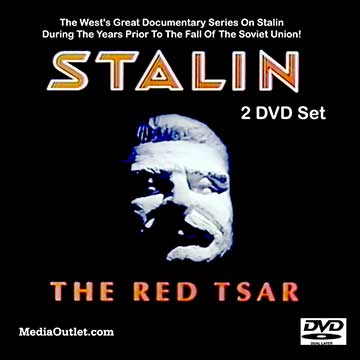
September 11, 1877: #BOTD: Felix
Dzerzhinsky, nicknamed "Iron Felix", Polish-Russian
Bolshevik revolutionary and official, educator, politician, leader
of the first two Soviet state-security organizations established
as secret police for the post-revolutionary Soviet regime - the
Cheka and the OGPU - and one of the architects of the Red Terror
and of decossackization (d. July 20, 1926) is #born Felix
Edmundovich Dzerzhinsky to ethnically Polish parents of noble
descent, at the Dzerzhinovo family estate, about 15 km (9.3 mi)
from the small town of Ivyanets in the Minsk Governorate of the
Russian Empire (now Belarus). In the Russian Empire, his family
was of a type known as "column-listed nobility"
(Russian: Stolbovoe Dvorianstvo), whose nobility was formally
acknowledged, but so old that they did not enjoy the privileges of
the new nobility. He was a member of several revolutionary
committees such as the Polish Revkom as well as several Russian
and Soviet official positions. Dzerzhinsky is best known for
establishing and developing the Soviet secret police forces,
serving as their director from 1917 until his death. Later he was
a member of the Soviet government heading several commissariats,
while being the chief of the Soviet secret police. The Cheka soon
became notorious for mass summary executions, performed especially
during the Red Terror and the Russian Civil War. Felix Dzerzhinsky
died of a heart attack in Moscow, Russian SFSR, Soviet Union,
immediately after a two-hour speech to the Bolshevik Central
Committee during which, visibly quite ill, he violently denounced
the United Opposition directed by Leon Trotsky, Grigory Zinoviev
and Lev Kamenev. Upon hearing of his death, Joseph Stalin
eulogized Dzerzhinsky as "a devout knight of the
proletariat". Dzerzhinsky was buried in the Kremlin Wall
Necropolis. Today his grave is one of the twelve individual tombs
located between the Lenin Mausoleum and the Kremlin Wall. On Sale
Until Midnight Tonight PT!
https://store.earthstation1.com/stalin-the-red-tsar-dvd-complete-4-part-tv-series-2-dis42.html
Today's
EarthStation1.com 15% (Or More!) Off Commemorative Memorial Title:
Russian Right Stuff: Soviet Space Program TV Series DVD, Download,
USB
Today, September 11, 2026
September 11, 1935: #BOTD: #HBD! Gherman
Titov, Russian general, pilot, and cosmonaut, who aboard Vostok 2
on August 6, 1961 became the second known human to orbit the
Earth, the fourth known person in space counting the suborbital
voyages of US astronauts Alan Shepard and Gus Grissom (d.
September 20, 2000) is #born Gherman Stepanovich Titov in the
village of Verkhneye Zhilino in the Altai Krai, a federal subject
of Russia (krai). Titov's flight finally proved that humans could
live and work in space. He was the first person to orbit the Earth
multiple times (a total of 17), to spend more than a day in space,
to sleep in orbit and to suffer from space sickness. In fact, he
also holds the record for being the first person to vomit in
space. He was the first to pilot a spaceship personally and he
made the first manual photographs from orbit, thus setting a
record for modern space photography. A month short of 26 years old
at launch, he remains the youngest person to fly in space. In his
subsequent life Titov continued to work for the Soviet space
program, playing a major role in the Spiral project where he
trained to become the first pilot of an orbital spaceplane.
However, after the death of Yuri Gagarin in a military aircraft
accident in 1968 the Soviet government decided it couldn't afford
to lose its second cosmonaut, and so Titov's career as test pilot
ended. Titov served in the Soviet Air Force and become a
colonel-general, and in his final years in post-Soviet Russia he
became a Communist politician. Despite having been chosen only
second after Gagarin to fly into space, it was Titov who later
proposed the Soviet Government regularly celebrate Cosmonautics
Day on April 12, the day of Gagarin's flight. Gherman Titov died
of cardiac arrest in his sauna at the age of 65 in Moscow, Russia.
He is buried in the Novodevichy Cemetery in Moscow. On Sale Until
Midnight Tonight PT!
https://store.earthstation1.com/russian-right-stuff-dvd-set-space-program-secret-history-2-disc2.html
Today's
EarthStation1.com 15% (Or More!) Off Commemorative Memorial Title:
The Great War (1964) TV Documentary Series DVD, Video Download,
USB
Today, September 11, 2026
September 11, 1862: #BOTD: #HBD! Julian
Byng, 1st Viscount Byng Of Vimy, English field marshal and
politician, 12th Governor General of Canada (d. June 6, 1935) is
#born Julian Hedworth George Byng to a noble family at the family
seat of Wrotham Park, in Hertfordshire, as the seventh son and
13th and youngest child of George Byng, 2nd Earl of Strafford
(who, due to the size of his family, ran a relatively frugal
household) and Harriet Elizabeth Cavendish, daughter of Charles
Cavendish, 1st Baron Chesham. Until the age of 17, Field Marshal
Julian Hedworth George Byng, 1st Viscount Byng Of Vimy, GCB (The
Most Honourable Order Of The Bath), GCMG (Sir Knight Grand Cross
Of The Most Distinguished Order Of Saint Michael And Saint
George), MVO (Knight Of The Royal Victorian Order) was enrolled at
Eton College, although he did not enter the sixth form. At Eton
Byng first received the nickname "Bungo" - to
distinguish him from his elder brothers "Byngo" and
"Bango" - but his time at the college was
undistinguished, and he received poor reports; indicative of his
attitude towards academics, he once traded his Latin grammar book
and his brother Lionel's best trousers to a hawker for a pair of
ferrets and a pineapple. Byng later claimed that he had been the
school's worst "Scug", the colloquial term for an
undistinguished boy. Upon graduation, he received a commission as
a militia officer and thereafter saw service in Egypt and Sudan
before he enrolled in the Staff College at Camberley. There, he
befriended individuals who would be his contemporaries when he
attained senior rank in France. Following distinguished service
during the First World War-specifically, with the British
Expeditionary Force in France, in the Battle Of Gallipoli, as
commander of the Canadian Corps at Vimy Ridge, and as commander of
the British Third Army Byng was in 1919 himself elevated to the
peerage. He was in 1921 appointed as governor general by King
George V, on the recommendation of Prime Minister of the United
Kingdom David Lloyd George, to replace the Duke of Devonshire as
viceroy, and occupied that post until succeeded by the Viscount
Willingdon in 1926. Byng proved to be popular with Canadians, due
to his war leadership, though stepping directly into political
affairs became the catalyst for widespread changes to the role of
the Crown in all of the British Dominions. After the end of his
viceregal tenure, Byng returned to be appointed Commissioner of
Police of the Metropolis and was promoted within the peerage to
become Viscount Byng Of Vimy. Three years after attaining the rank
of field marshal, Byng died of an abdominal blockage at his home,
Thorpe Hall, at Thorpe-le-Soken in Essex, England, aged 72. He is
buried in St. Leonard's Churchyard in Beaumont, England. On Sale
Until Midnight Tonight PT!
https://store.earthstation1.com/the-great-war-dvd-set-1964-wwi-tv-series-26-shows-1964266.html
Today's
EarthStation1.com 15% (Or More!) Off Commemorative Memorial Title:
All The Fine Young Men: The US 8th Air Force In WWII + Bonus MP4
DVD
Today, September 11, 2026
September 11, 1924: #BOTD: #HBD! Tom
Landry, American professional football coach, player, and United
States Eighth Air Force pilot (d. February 12, 2000) is born
Thomas Wade Landry in Mission, Texas. Regarded as one of the
greatest head coaches of all time, he was the first head coach of
the Dallas Cowboys in the National Football League (NFL), a
position he held for 29 seasons. During his coaching career, he
created many new formations and methods, such as the now default
4-3 defense that is used by a majority of teams in the NFL, and
the "flex defense" system made famous by the "Doomsday
Defense" squads he built during his tenure with the Cowboys.
His 29 consecutive years from 1960 to 1988 as the coach of one
team is an NFL record, along with his 20 consecutive winning
seasons, which is considered to be his most impressive
professional accomplishment. Landry died aged 75 in Dallas, Texas
after battling leukemia. Landry's funeral service was held at
Highland Park United Methodist Church, where he was an active and
committed member for 43 years. He was interred in the
Sparkman-Hillcrest Memorial Park Cemetery in Dallas. A cenotaph
dedicated to Landry, complete with a depiction of his trademark
fedora hat, was placed in the official Texas State Cemetery in
Austin at the family's request. Landry attended the University of
Texas at Austin as an industrial engineering major. Landry had
given thought to enrolling at Mississippi State University, where
his friend John Tripson was an All-American, but did not want to
be far away from his friends and family in Texas. The main driving
force in keeping him from enrolling at Mississippi State
University was the notion that it would be too long a travel for
his parents to see him play college football.He interrupted his
education after a semester to serve in the United States Army Air
Corps during World War II. Landry was inspired to join the armed
forces by his brother Robert Landry, who had enlisted in the Army
Air Corps after the attack on Pearl Harbor. While ferrying a B-17
over to England, Robert Landry's plane had gone down over the
North Atlantic, close to Iceland. Several weeks passed before the
Army was able to officially declare Robert Landry dead. Landry
began his basic training at Sheppard Field near Wichita Falls,
Texas (now Sheppard AFB), and his preflight training at Kelly
Field (now Kelly Field), located near San Antonio, Texas. Landry's
first experience as a bomber pilot was a tough one. A few minutes
after takeoff, Landry noticed that the pilot seemed to be working
furiously, causing him to realize that the plane's engine had
died. Despite this experience, Landry was committed to flying. At
the age of 19, Landry was transferred to Sioux City, Iowa, where
he trained as a copilot on the Boeing B-17 Flying Fortress heavy
bomber. In 1944, Landry got his orders, and from Sioux City he
went to Liverpool, England, where he was assigned to the Eighth
Air Force, in Ipswich. Landry earned his wings and a commission as
a Second Lieutenant at Lubbock Army Air Field, and was assigned to
the 493d Bombardment Group at RAF Debach, England, in the 860th
Bombardment Squadron. From November 1944 to April 1945, he
completed a combat tour of 26 missions, (his entire crew went on
29 missions and Landry did not go on 3 of them), he also survived
a crash landing in Belgium after his bomber ran out of fuel. He
returned to his studies at the University of Texas in the fall of
1946. On Sale Until Midnight Tonight PT!
https://store.earthstation1.com/all-the-fine-young-men-the-us-8th-air-force-in-wwii-dv8.html
Today's
EarthStation1.com 15% (Or More!) Off Commemorative Memorial Title:
The Gallant Breed: US Marine Chronicles + 2 Bonuses MP4 Download
DVD
Today, September 11, 2026
September 11, 1919: Imperialism: American
Imperialism: The History Of American Imperialism: American
Imperialism In Central America: Honduras: The United States
Invasion Of Honduras: -- The United States lands United States
Marine Corps troops in Honduras to overthrow Honduran President
Francisco Bertrand and prevent his fixing the upcoming Honduran
elections. In 1919, it became obvious that President Bertrand
would refuse to allow an open election to choose his successor.
This course of action was opposed by the United States and had
little popular support in Honduras. The local military commander
and governor of Tegucigalpa, General Rafael Lopez Gutierrez, took
the lead in organizing opposition to Bertrand by the Liberal Party
Of Honduras (PLH). Lopez Gutierrez also solicited support from the
liberal government of Guatemala and even from the conservative
regime in Nicaragua. Bertrand, in turn, sought support from El
Salvador. Determined to avoid an international conflict, the
United States government, after some hesitation, offered to
meditate the dispute, hinting to the Honduran president that if he
refused the offer, open intervention might follow; as American
corporations consolidated increasingly large landholdings in
Honduras, they lobbied the US government to protect their
investments, and as Honduras was effectively controlled by
American fruit corporations, it was the original inspiration for
the term "banana republic". Conflicts over land
ownership, peasant rights, and a US-aligned comprador class of
elites led to such conflicts armed conflicts and multiple
invasions by US armed forces. In the first decades of the century,
US military incursions took place in 1903, 1907, 1911, 1912, 1919,
1924, and 1925 for similar reasons. When US Marines landed in
Honduras, Bertrand promptly resigned and left the country. The
United States ambassador helped install an interim government
headed by Francisco Bogran, who promised to hold free elections.
General Lopez Gutierrez, who now controlled the military, made it
clear that he was determined to be the next president. After
considerable negotiation and some confusion, a formula was worked
out under which elections were held. Lopez Gutierrez won easily in
a manipulated election, and in October 1920 he assumed the
presidency; ironic, as the original reason for invading Honduras
was to prevent such a manipulated election from being held. On
Sale Until Midnight Tonight PT!
https://store.earthstation1.com/the-gallant-breed-dvd-set-3-part-us-marine-history-2-dis32.html
Today's
EarthStation1.com 15% (Or More!) Off Commemorative Memorial Title:
The American Adventure: TV History Series 1607-1876 DVD MP4 USB
Drive
Today, September 11, 2026
September 11, 1789: The United States:
The History Of The United States: The Cabinet Of The United
States: The Secretary Of The Treasury: -- Alexander Hamilton is
appointed the first United States Secretary of the Treasury. The
secretary of the treasury is the head of the United States
Department of the Treasury, which is concerned with all financial
and monetary matters relating to the federal government, and,
until 2003, also included several major federal law enforcement
agencies. This position in the federal government of the United
States is analogous to the minister of finance in many other
countries. The secretary of the treasury is a member of the
president's Cabinet, and is nominated by the president of the
United States. Nominees for Secretary of the Treasury undergo a
confirmation hearing before the United States Senate Committee on
Finance before being voted on by the United States Senate. The
secretary of the treasury, the Secretary Of State, the attorney
general, and the Secretary Of Defense are generally regarded as
the four most important cabinet officials because of the size and
importance of their respective departments. The secretary of the
treasury is a non-statutory member of the U.S. National Security
Council and fifth in the United States presidential line of
succession. January 11, 1755: Alexander Hamilton (1755-1804) was
#born in the British West Indies. He was a founder of the U.S. who
favored a strong central government and co-authored the Federalist
Papers, a series of essays in defense of the new constitution. He
was selected by George Washington to be the first Secretary of the
Treasury. He died from a gunshot wound received during a duel with
Aaron Burr. On Sale Until Midnight Tonight PT!
https://store.earthstation1.com/the-american-adventure-series-us-1st-century-4-dv14.html
Today's
EarthStation1.com 15% (Or More!) Off Commemorative Memorial Title:
Subways Trains & Railroads! Rail Transport History DVD,
Download, USB
Today, September 11, 2026
September 11, 1972: The History Of Rail
Transport (The History Of Railways): Rapid Transit (Mass Rapid
Transit [MRT], Heavy Rail, Metro): The Bay Area Rapid Transit
System (BART): -- San Francisco's Bay Area Rapid Transit (BART)
system begins passenger service. This heavy rail elevated and
subway system connects San Francisco with cities in Alameda,
Contra Costa, and San Mateo counties. BART utilizes the third rail
system of electrification and power, and operates six routes on
112 miles (180 km) of track connecting 46 stations: this includes
a 3.2-mile (5.1 km) automated guideway transit line to the Oakland
International Airport. A ten-mile spur line in eastern Contra
Costa County will utilize a third set of rail technologies. With
an average of 433,000 weekday passengers and 128.5 million annual
passengers in fiscal year 2016, BART is the fifth-busiest heavy
rail rapid transit system in the United States. BART is operated
by the San Francisco Bay Area Rapid Transit District, formed in
1957. As of 2017, it is being expanded to San Jose with the
contiguous Warm Springs and Silicon Valley BART extensions. On
Sale Until Midnight Tonight PT!
https://store.earthstation1.com/subways-trains-and-railroads-locomotive-films-2-dual-layer-dvd2.html
Today's
EarthStation1.com 15% (Or More!) Off Commemorative Memorial Title:
Prisoners Of Propaganda: Pacific War Australian POW DVD, Download,
USB
Today, September 11, 2026
September 11, 1945: World War II: The
Pacific War (The Asia-Pacific War, The Asiatic-Pacific Theater,
The Pacific Theater Of World War II): The Pacific Ocean Theater Of
World War II: The South West Pacific Area (SWPA): The Borneo
Campaign (The Second Battle Of Borneo, Operation Oboe): The
Liberation Of Batu Lintang Camp (The Lintang Barracks, The Kuching
POW Camp): -- Australian 9th Division forces liberate the
Japanese-run Batu Lintang Camp, a POW and civilian internment
campat Kuching, Sarawak on the island of Borneo. Batu Lintang Camp
was unusual in that it housed both Allied prisoners of war (POWs)
and civilian internees. The camp, which operated from March 1942
until the liberation of the camp was housed in buildings that were
originally British Indian Army barracks. The original area was
extended by the Japanese, until it covered about 50 acres (20
hectares). The camp population fluctuated, due to movement of
prisoners between camps in Borneo, and as a result of the deaths
of the prisoners. It had a maximum population of some 3,000
prisoners. Life in the camp was harsh, with POWs and internees
alike forced to endure food shortages, disease and sickness for
which scant medicine was made available, forced labour, brutal
treatment, and lack of adequate clothing and living quarters. Of
the approximately 2,000 British POWs held there, over two-thirds
died during or as a result of their captivity. The construction
and operation of a secret radio for over 2 1/2 years, from
February 1943 until the liberation of the camp, was a morale
booster and allowed the prisoners to follow the progress of the
war. Discovery would have resulted in certain death for those
involved. On liberation, the camp population was 2,024, of whom
1,392 were POWs, 395 were male civilian internees and 237 were
civilian women and children. Amongst official Japanese papers
found at the camp following its liberation were two "death
orders". Both described the proposed method of execution of
every POW and internee in the camp. The first order, scheduled for
enactment on 17 or 18 August, was not carried out; the second was
scheduled to take place on 15 September. The timely liberation of
the camp may have prevented the murder of over 2,000 men, women
and children. In July 1948, a teachers' training college moved to
the site, where it continues to this day, the oldest such
establishment in Malaysia. On Sale Until Midnight Tonight PT!
https://store.earthstation1.com/prisoners-of-propaganda-dvd-wwii-australian-pow-films.html
Today's
EarthStation1.com 15% (Or More!) Off Commemorative Memorial Title:
The Twentieth Century With Walter Cronkite TV Series DVD MP4 USB
Drive
Today, September 11, 2026
September 11-12, 1944: The European Civil
War: World War II: The Second European War (The European Theater
Of World War II): The Western Front Of World War II: Aviation:
Military Aviation: Air Warfare Of World War II: Strategic Bombing
During World War II: European Air Operations During The Battle Of
Europe: RAF Strategic Bombing During The Second World War: The
Bombing Of Darmstadt In World War II: -- No. 5 Group conducts an
RAF bombing raid on Darmstadt, and the resulting firestorm results
in the loss of between 12,500 and 13,500 inhabitants and the
homelessness of between 66,000 of the 110,000 inhabitants.
Darmstadt had several major industrial targets, including Merck
and Rohm and Haas chemical works, as well as military
communications networks. Darmstadt was bombed a number of times
during World War II, but this was the most devastating air raid on
the city. On Sale Until Midnight Tonight PT!
https://store.earthstation1.com/the-twentieth-century-with-walter-cronkite-5-dual-layer-dvd5.html
Today's
EarthStation1.com 15% (Or More!) Off Commemorative Memorial Title:
CIA The Secret Files The Central Intelligence Agency TV Series MP4
DVD
Today, September 11, 2026
September 11, 1973: The Aftermath Of
World War II: The Cold War: The Cold War In South America: Chile:
The History Of Chile: The 1973 Chilean Coup D'Etat (The
Assassination Of Salvador Allende): The Military Dictatorship Of
Chile (1973-1990): -- #DOTD: #RIP: Salvador Allende, Chilean
physician and socialist politician who served as the 29th
president of Chile from November 3, 1970 (b. 1908) #dies when The
Government Junta Of Chile, a military junta headed by Chilean
General Augusto Pinochet and supported by the United States
Central Intelligence Agency (CIA), topples the democratically
president and his government in a coup d'etat, establishing The
Military Dictatorship Of Chile (1973-1990), and ending more than
four decades of uninterrupted democratic governance. As troops
surrounded La Moneda Palace, he gave his last speech vowing not to
resign. Later that day, Allende committed suicide though there has
been some controversy about the cause of his death with some
believing it to be an assassination. He is buried at The
Cementerio General De Santiago in Santiago, Chile. Following
Allende's death, General Pinochet refused to return authority to a
civilian government. The junta then dissolved the Congress of
Chile, suspended the Constitution, and began a program of
persecuting alleged dissidents, in which at least 3,095 civilians
disappeared or were killed. Pinochet exercised dictatorial power
in Chile until ousted in a referendum in 1988. Despite this
ouster, Pinochet stayed in power as the head of a ruling military
junta until The Chilean Transition To Democracy in 1990. Salvador
Allende was born Salvador Guillermo Allende Gossens in Santiago,
Chile. He won the 1970 Chilean Presidential Election on September
4, 1970, becoming the first Marxist to be elected president of a
Latin American liberal democracy, and the first Marxist to win the
presidency of a Latin American country through open elections.
Allende's involvement in Chilean politics spanned a period of
nearly forty years, having covered the posts of senator, deputy
and cabinet minister. As a life-long committed member of the
Socialist Party of Chile, whose foundation he had actively
contributed to, he unsuccessfully ran for the national presidency
in the 1952, 1958, and 1964 elections. In 1970, he won the
presidency as the candidate of the Popular Unity coalition, in a
close three-way race. He was elected in a run-off by Congress, as
no candidate had gained a majority. As president, Allende sought
to nationalize major industries, expand education and improve the
living standards of the working class. He clashed with the
right-wing parties that controlled Congress and with the
judiciary. On Sale Until Midnight Tonight PT!
https://store.earthstation1.com/cia-the-secret-files-the-central-intelligence-agency-tv-series-mp4-dv4.html
Today's
EarthStation1.com 15% (Or More!) Off Commemorative Memorial Title:
A Rustling Of Leaves: Inside The Philippine Revolution DVD, MP4,
USB
Today, September 11, 2026
September 11, 1917: #BOTD: Ferdinand
Marcos, Filipino lawyer and politician, 10th President of the
Philippines (d. September 28, 1989) is #born Ferdinand Emmanuel
Edralin Marcos in Sarrat, Philippines. Ferdinand Emmanuel Edralin
Marcos, Sr. was a Filipino politician and kleptocrat who was
President of the Philippines from 1965 to 1986. He ruled as a
dictator under martial law from 1972 until 1981. His regime was
infamous for its corruption, extravagance and brutality. Marcos
claimed an active part in World War II, including fighting
alongside the Americans in the Bataan Death March and being the
"most decorated war hero in the Philippines". A number
of his claims were found to be false and United States Army
documents described Marcos' wartime claims as "fraudulent"
and "absurd". Marcos started as an attorney, then served
in the Philippine House of Representatives from 1949 to 1959 and
the Philippine Senate from 1959 to 1965. He was elected President
in 1965, and presided over a growing economy during the beginning
and intermediate portion of his 20-year rule, but ended in loss of
livelihood, extreme poverty and a crushing debt crisis. Marcos
placed the Philippines under martial law on September 23, 1972,
during which he revamped the constitution, silenced the media, and
used violence and oppression against the political opposition,
Muslims, communist rebels, and ordinary citizens. Martial law was
ratified by 90.77% of the voters during the Philippine Martial Law
referendum, 1973 though the referendum was marred with
controversy. Public outrage led to the snap elections of 1986.
Allegations of mass cheating, political turmoil and excesses of
human rights abuses led to the People Power Revolution in February
1986, which removed him from power. To avoid what could have been
a military confrontation in Manila between pro- and anti-Marcos
troops, Marcos was advised by President Ronald Reagan through Sen.
Paul Laxalt to "cut and cut cleanly", after which Marcos
fled to Hawaii. Marcos was succeeded by Corazon "Cory"
Aquino, widow of the assassinated opposition leader Senator
Benigno "Ninoy" Aquino, Jr. who had flown back to the
Philippines to face Marcos. According to source documents provided
by the Presidential Commission on Good Government, the Marcos
family had stolen 5-10B USD. The PCGG also maintained that the
Marcos family enjoyed a decadent lifestyle-taking away billions of
dollars from the country between 1965 and 1986. His wife Imelda
Marcos, whose excesses during the couple's conjugal dictatorship
made her infamous in her own right, spawned the term "Imeldific".
Ferdinand Marcos died at St. Francis Medical Center in Honolulu at
12:40 a.m (HST) of kidney, heart, and lung ailments, 17 days after
his 72nd birthday. Marcos was interred in a private mausoleum at
Byodo-In Temple on the island of Oahu where his remains were
visited daily by the Marcos family, political allies and friends.
The Aquino government refused to allow Marcos's body to be brought
back to the Philippines. The body was only brought back to the
Philippines four years after Marcos's death during the term of
President Fidel Ramos. From 1993 to 2016, Marcos' remains were
interred inside a refrigerated, frozen crypt in Batac, Ilocos
Norte, where his son, Ferdinand Jr., and eldest daughter, Imee,
have since become the local governor and congressional
representative, respectively. A large bust of Ferdinand Marcos
inspired by Mount Rushmore was commissioned by the tourism
minister, Jose Aspiras, and carved into a hillside in Benguet. It
was subsequently destroyed; suspects included left-wing activists,
members of a local tribe who had been displaced by construction of
the monument, and looters hunting for the legendary Yamashita
Treasure, also referred to as Yamashita's Gold, the alleged war
loot stolen in Southeast Asia by Imperial Japanese forces during
World War II and supposedly hidden in caves, tunnels, or
underground complexes in different cities in the Philippines,
named after Japanese general and convicted war criminal Tomoyuki
Yamashita. On November 18, 2016, the remains of Marcos were buried
at the Libingan ng mga Bayani, ordered by President Rodrigo
Duterte despite opposition from various groups. The burial came as
unexpected to many, as the Supreme Court's ruling still allowed 15
days for the opposition to file a motion for reconsideration. On
the morning of November 18, using Philippine Armed Forces
helicopters, his family and their supporters flew his remains from
Ilocos to Manila for a private burial. There has been actual
controversy as to the physical interment, for the body was in
frozen display at Batac, which display was then said to be a hoax,
and that the real body was already sent to Taguig. However,
according to lawyer Chel Diokno and in other media coverage, there
were no reports, records, or sightings of any actual transfer of
the frozen body in Batac to the Libingan ng Mga Bayani, thereby
raising speculation as to the truth of the location of Marcos's
real remains. Various protest groups formed immediately upon
hearing the news of the unexpected burial. Among those who
gathered to oppose the burial were youth groups and opponents of
the burial of Marcos in the Libingan ng mga Bayani. The League of
Filipino Students described the transfer of Marcos's remains as
being done like "a thief in the night". They also
criticized the government's involvement in the burial of the
former president who they described as a "fascist dictator".
The Kabataan Partylist also condemned the burial, labeling it as a
"grave travesty" and as "galawang Hokage" in
reference to the burial of Marcos being planned and conducted
unbeknownst to the public. Students of the Ateneo de Manila
University protested along Katipunan Avenue in Quezon City, Metro
Manila protested against the burial of Marcos, insisting that the
former president was a dictator, not a hero. On Sale Until
Midnight Tonight PT!
https://store.earthstation1.com/a-rustling-of-leaves-inside-the-philippine-revolution-dvd.html
Today's
EarthStation1.com 15% (Or More!) Off Commemorative Memorial Title:
The Capitalist Cartoons Of John Sutherland MP4 Video Download DVD
Today, September 11, 2026
September 11, 1910: #BOTD: #HBD! John
Sutherland, American animator, voice artist and film producer (d.
February 17, 2001) is #born John Elliott Sutherland in Williston,
North Dakota. Sutherland was an animator on the 1931 short film
The Beach Party and voiced the adult Bambi in the 1942 film Bambi.
Sutherland produced 45 films from 1945-1973. Many of his films
were instructional cartoons produced for Harding College extolling
the socioeconomic concept of capitalism and delivering a political
message on the benefits of both corporate and individual liberty,
and the drawbacks of government intervention, particularly with
Make Mine Freedom and Fresh Laid Plans. Sutherland moved to Los
Angeles, California, to work in the film industry. He started his
career as an animator in 1931, with a short film, The Beach Party.
While in Los Angeles, Sutherland married Paula Winslowe on
September 16, 1939, and had four children. Winslowe also worked on
the Walt Disney film Bambi, where she voiced the mother of his
character. Sutherland quit the film industry in 1973, and moved to
Van Nuys, California, where he died in his home, aged 90. He is
buried at Holy Cross Cemetery in Culver City, Los Angeles County,
California. On Sale Until Midnight Tonight PT!
https://store.earthstation1.com/capitalist-cartoons-us-probusiness-propaganda-animation-dvd.html
Today's
EarthStation1.com 15% (Or More!) Off Commemorative Memorial Title:
Bob Marley And The Wailers (1986) Documentary MP4 Video Download
DVD
Today, September 11, 2026
September 11, 1987: #DOTD: #RIP: Peter
Tosh, Jamaican singer-songwriter and guitarist, he was one of the
core members along with Bob Marley and Bunny Wailer of the band
The Wailers (1963-1976), after which he established himself as a
successful solo artist and a promoter of Rastafari (b. (October 19
1944) #dies when he was shot twice in the head during a home
invasion. He is buried at The Peter Tosh Mausoleum in Bluefields,
Westmoreland, Jamaica. A three-man gang came to his house on
motorcycles demanding money. Tosh replied that he did not have any
with him but the gang did not believe him. They stayed at his
residence for several hours and tortured Tosh in an attempt to
extort money from him. Over the hours, as various associates of
Tosh arrived to visit him, they were also taken hostage by the
gunmen. The gunmen became more and more frustrated, especially the
chief thug, Dennis "Leppo" Lobban, a man whom Tosh had
previously befriended and tried to help find work after a long
jail sentence. Tosh said he did not have any money in the house,
after which Lobban and the fellow gunmen began opening fire in a
reckless manner. Tosh was shot twice in the head and killed.
Herbalist Wilton "Doc" Brown and disc jockey Jeff 'Free
I' Dixon also died as a result of wounds sustained during the
robbery. Several others in the house were wounded, including
Tosh's common law wife Andrea Marlene Brown, Free I's wife Yvonne
("Joy"); Tosh's drummer Carlton "Santa" Davis,
and musician Michael Robinson. According to Police Commissioner
Herman Ricketts, Dennis "Leppo" Lobban surrendered and
two other men were interrogated but not publicly named. Lobban
went on to plead innocent during his trial, telling the court he
had been drinking with friends. The trial was held in a closed
court due to the involvement of illegal firearms. Lobban was
ultimately found guilty by a jury of eight women and four men and
sentenced to death by hanging. His sentence was commuted in 1995
and Lobban remains in jail. Another suspect was acquitted due to
insufficient evidence. The other two gunmen were never identified
by name. Peter Tosh, OM (Order Of Merit) was born Winston Hubert
McIntosh in Westmoreland, the westernmost parish of Jamaica. He
was abandoned by his parents and "shuffled among relatives".
When McIntosh was fifteen, his aunt died and he moved to
Trenchtown in Kingston, Jamaica. He first learned guitar after
watching a man in the country play a song that captivated him. He
watched the man play the same song for half a day, memorizing
everything his fingers were doing. He then picked up the guitar
and played the song back to the man. The man then asked McIntosh
who had taught him to play; McIntosh told him that he had. During
the early 1960s, as an aspiring musician, Tosh went to vocal
teacher Joe Higgs, who gave free music lessons to young people.
Through his contact with Higgs, Tosh met Robert Nesta Marley (Bob
Marley) and Neville O'Reilly Livingston (Bunny Wailer). He then
changed his name to Peter Tosh and the trio started singing
together in 1962. By 1964, Tosh, Marley, and Bunny had formed the
Wailing Wailers, with falsetto singer Junior Braithwaite, and
backup singers Beverley Kelso and Cherry Smith. Initially, Tosh
was the only one in the group who could play musical instruments.
According to Bunny Wailer, Tosh was critical to the band because
he was a self-taught guitarist and keyboardist, and thus became an
inspiration for the other band members to learn to play. The
Wailing Wailers had a major ska hit with their first single,
"Simmer Down", and recorded several more successful
singles before Braithwaite, Kelso and Smith left the band in late
1965. Marley spent much of 1966 in Delaware in the United States
with his mother, Cedella (nee Malcolm) Marley-Booker, and for a
brief time was working at a nearby Chrysler factory. He returned
to Jamaica in early 1967 with a renewed interest in music and a
new spirituality. Tosh and Bunny were already Rastafarians when
Marley returned from the US, and the three became very involved
with the Rastafari faith. Soon afterwards, they renamed the
musical group the Wailers. Tosh would explain later that they
chose the name Wailers because to "wail" means to mourn
or to, as he put it, "...express one's feelings vocally".
He also claims that he was the beginning of the group, and that it
was he who first taught Bob Marley the guitar. Also according to
Bunny Wailer, the early Wailers learned to play instruments from
Tosh. During the mid-1960s Tosh, along with Bob Marley and Bunny
Wailer, were introduced to Danny Sims and Johnny Nash who signed
the three artists to an exclusive recording contract on Sims' and
Nash's JAD Records label as well as an exclusive publishing
agreement through Sims' music publishing company, Cayman Music.
Rejecting the up-tempo dance of ska, the band slowed their music
to a rocksteady pace, and infused their lyrics with political and
social messages inspired by their new-found faith. The Wailers
composed several songs for the American-born singer Nash before
teaming with producer Lee "Scratch" Perry to record some
of the earliest well-known reggae songs, including "Soul
Rebel", "Duppy Conqueror", and "Small Axe".
The collaboration had given birth to reggae music and in 1970
bassist Aston "Family Man" Barrett and his brother,
drummer Carlton Barrett, joined the group. They recorded the album
The Best of The Wailers, which was produced by Leslie Kong and
released in 1971. In 1972, Danny Sims assigned the balance of the
JAD Records recording contract with the band to Chris Blackwell
and Island Records company and released their debut, Catch a Fire,
in 1973, following it with Burnin' the same year. The Wailers had
moved from many producers after 1970 and there were instances
where producers would record rehearsal sessions that Tosh did and
release them in England under the name "Peter Touch". In
1973, Tosh was driving home with his girlfriend Evonne when his
car was hit by another car driving on the wrong side of the road.
The accident killed Evonne and severely fractured Tosh's skull.
After Island Records president Chris Blackwell refused to issue
his solo album in 1974, Tosh and Bunny Wailer left the Wailers,
citing the unfair treatment they received from Blackwell, to whom
Tosh often referred with a derogatory play on Blackwell's surname,
'Whiteworst'. Tosh had written many of the Wailers' hit songs such
as "Get Up, Stand Up", "400 Years", and "No
Sympathy". Tosh began recording and released his solo debut,
Legalize It, in 1976 with CBS Records company, and Treasure Isle.
The title track soon became popular among endorsers of cannabis
legalization, reggae music lovers and Rastafari all over the
world, and was a favourite at Tosh's concerts. That was his last
album from the Wailers, Island Records. In 2013, a book co-written
by French scholar Dr Jeremie Kroubo Dagnini and American Lee
Jaffe, his former associate, says Tosh was part of a smuggling
operation that raised money to fund this album. Tosh started to
make his own albums with Rolling Stones Records and CBS Records
Equal Rights followed in 1977, featuring his recording of a song
co-written with Marley, "Get Up, Stand Up", and a cover
of "Stepping Razor" that would also appear on the
soundtrack to the film Rockers. Tosh organised a backing band,
Word, Sound and Power, who were to accompany him on tour for the
next few years, and many of whom performed on his albums of this
period. In 1978, the Rolling Stones record label Rolling Stones
Records contracted with Tosh, on which the album Bush Doctor was
released, introducing Tosh to a larger audience. The album
featured Rolling Stones frontmen Mick Jagger and Keith Richards,
and the lead single - a cover version of The Temptations song
"Don't Look Back" - was performed as a duet with Jagger.
During Bob Marley's free One Love Peace Concert of 1978, Tosh lit
a marijuana spliff and lectured about legalising cannabis,
lambasting attending dignitaries Michael Manley and Edward Seaga
for their failure to enact such legislation. Several months later
he was apprehended by police as he left Skateland dance hall in
Kingston and was beaten severely while in police custody. Mystic
Man (1979), and Wanted Dread and Alive (1981) followed, both
released on Rolling Stones Records. Tosh tried to gain some
mainstream success while keeping his militant views, but was only
moderately successful, especially when compared to Marley's
achievements. In 1984, after the release of 1983's album Mama
Africa, Tosh went into self-imposed exile, seeking the spiritual
advice of traditional medicine men in Africa, and trying to free
himself from recording agreements that distributed his records in
South Africa. Tosh had been at odds for several years with his
label, EMI, over a perceived lack of promotion for his music. Tosh
also participated in the international opposition to South African
apartheid by appearing at anti-apartheid concerts and by conveying
his opinion in various songs like "Apartheid" (1977,
re-recorded 1987), "Equal Rights" (1977), "Fight
On" (1979), and "Not Gonna Give It Up" (1983). In
1987, Peter Tosh seemed to be having a career revival. He was
awarded a Grammy Award for Best Reggae Performance in 1987 for No
Nuclear War, his last record. A monument to Tosh is maintained by
his family near Negril, Jamaica and is open to the public. His
birthday is celebrated there annually with live reggae music. In
October 2012 Tosh was posthumously awarded Jamaica's fourth
highest honour, the Order of Merit. A square on Trafalgar Road in
Kingston was renamed Peter Tosh Square. The square is home to the
Peter Tosh Museum, which opened in October 2016. Among the
artifacts on display is Tosh's M16 guitar. In 2015, Tosh's
daughter - the administrator of the Peter Tosh Estate - deemed
that April 20 should be celebrated as International Peter Tosh
Day, in honour of his "philosophy of responsible cannabis
consumption for medicinal and spiritual health benefits". A
1964 photograph of Tosh in sunglasses and suit with Bob Marley and
the other Wailers was used in 1979 as the inspiration for the logo
of the 2 Tone Records music label which released albums from ska
bands such as The Specials. The logo featured a stylized figure
with a suit and posture based on the depiction of Tosh from the
photo though this figure was called "Walt Jabsco". The 2
Tone Records logo in return was the inspiration for a drawing in a
Microsoft font. This version of Tosh was designed as a part of
Webdings designed by Vincent Connare in 1997. The font did not
feature letters or numbers like other fonts but instead had
symbols and was intended for use alongside other fonts for text.
Connare was a fan of The Specials and he saw Walt Jabsco on one of
their albums and decided to use it as the basis of one of the
Webdings symbols, changing the design so Tosh faced forward and
floated with his shadow shown below. In Webdings, Tosh is seen by
typing a lowercase "m". Connare's Webdings design was
incorporated into the emoji system in 2014 under the name "Man
in Business Suit Levitating emoji" with the code with the
designation U+1F574 ?? MAN IN BUSINESS SUIT LEVITATING. Tosh's
children Andrew Tosh and Niambe McIntosh both praised the emoji in
a 2021 BBC interview, with Andrew stating that "wanted
[people] to dance to their own (political) awakening". The
annual Peter Tosh Gala Awards event was inaugurated in 2017. In
October 2019, a commemorative blue plaque dedicated by the Nubian
Jak Community Trust honoring Bob Marley, Peter Tosh, and Bunny
Wailer was placed at the former site of Basing Street Studios in
London, where Catch a Fire and Burnin' were completed. In 2023 he
was posthumously bestowed with the Order of the Companions of O.
R. Tambo. In 1983, at the Los Angeles stop on Tosh's Mama Africa
tour, a local musician named Bruno Coon went to the hotel at which
Tosh was staying, claiming to have a gift for him. The gift was a
custom-built guitar in the shape of an M16 rifle. Tosh accepted
the gift personally. The guitar was subsequently lost by the
airlines when the tour went to Europe but was recovered when
Tosh's public relations agent placed an article about its loss in
Der Spiegel. Tosh went on to perform on stage with the guitar. The
promoters of the Flashpoint Film Festival announced in 2006 that
Tosh's common-law wife Andrea "Marlene" Brown would
auction it on eBay. Tosh's sons, Andrew Tosh, and Jawara McIntosh,
prevented the sale, claiming ownership of the guitar.] In 2011
Andrew Tosh said that the guitar was in the custody of a close
friend, awaiting the opening of a museum dedicated to Peter Tosh.
The Peter Tosh Museum was opened on Peter Tosh's 72nd birthday on
19 October 2016 in Kingston, Jamaica. Along with Bob Marley and
Bunny Wailer during the late 1960s, Peter Tosh became a devotee of
Rastafari. One of the beliefs of the Rastas is that Haile
Selassie, the Emperor of Ethiopia, was either an embodiment of God
or a messenger of God, leading the three friends to be baptized in
the Ethiopian Orthodox Church. At some point after his departure
from the Wailers, Tosh developed an interest in unicycles and
became a unicycle rider, being able to ride forwards and backwards
and hop. He often amused his audiences by riding onto the stage on
his unicycle for his shows. On Sale Until Midnight Tonight PT!
https://store.earthstation1.com/bob-marley-and-the-wailers-dvd-1986-documen1986.html
Today's
EarthStation1.com 15% (Or More!) Off Commemorative Memorial Title:
Color Adjustment 40 Years Of Black America On Broadcast TV DVD MP4
USB
Today, September 11, 2026
September 11, 1977: The History Of
Broadcasting: The History Of Television Broadcasting: The Emmy
Awards (The Emmys): The 29th Emmy Awards (The 29th Primetime Emmy
Awards): -- The 29th Primetime Emmy Awards, a multiply historic
event, is held on Sunday night at the Pasadena Civic Auditorium,
Pasadena, California, beginning the long residency of the
Primetime Emmys at the Pasadena Civic Auditorium, which would
continue twenty years until 1997. The ceremony was broadcast on
NBC. It was hosted by Angie Dickinson and Robert Blake. The top
shows of the night were Mary Tyler Moore, which, in its final
season, won its third consecutive Outstanding Comedy Series Award,
it also became the first comedy series to gain eleven major
nominations (since broken). Upstairs, Downstairs, also in its
final season, won its third Outstanding Drama Series Award in four
years (it competed as a miniseries in 1976, and won that category
too). But the overwhelming champion of the ceremony was the
miniseries Roots. Roots set several milestones and broke multiple
records during the night. It became the first show to receive at
least twenty major nominations (21). Adding its nominations in
Creative Arts categories, its total expands to 37. Both records
still stand for all shows. It was the first show to gain every
nomination in an acting category. Its thirteen acting nominations
tied the record set the previous year by Rich Man, Poor Man,
however all of Roots' nominations came in the miniseries category,
while Rich Man, Poor Man had nominations cross over into the drama
series field. Roots became the first miniseries, and second show
overall, along with All in the Family in 1972, to win six of seven
major categories. All but one of Roots' eight episodes were
nominated for major awards (Part VII). Other distinctions included
Mary Kay Place winning a Major Acting award for a TV show (Mary
Hartman, Mary Hartman) that had no major network, only broadcast
in Syndication - the first time this rare feat has occurred. Also,
with actress Rita Moreno's win for her guest appearance on The
Muppet Show, she became the third person after Richard Rodgers and
Helen Hayes to achieve all four major entertainment awards (EGOT).
On Sale Until Midnight Tonight PT!
https://store.earthstation1.com/color-adjustment-40-years-of-black-americans-on-tv-dvd-download-u40.html
Today's
EarthStation1.com 15% (Or More!) Off Commemorative Memorial Title:
WABC Radio Airchecks MP3 Collection 1960s-1980s DVD, MP3 Download,
USB
Today, September 11, 2026
September 11, 1943: #BOTD: #HBD! Jack
Ely, American guitarist and singer, best known for singing the
Kingsmen's version of "Louie Louie" (d. April 28, 2015)
is #Jack Brown Ely in Portland, Oregon. Classically trained in
piano, he began playing guitar after seeing Elvis Presley on
television. In 1959, he co-founded the Kingsmen and with them
recorded "Louie Louie" in 1963; Ely's famously
incoherent vocals were partly the result of his braces and the
rudimentary recording method. Ely was enrolled at Washington High
School in Portland, Oregon. He did not play in the school band,
but had a passion for singing. In 1959, Lynn Easton's mother
invited him to play at a Portland hotel gig, with Ely singing and
playing guitar with the backup band and Easton on the drum kit.
The two teenagers had grown up together, as their parents were
close friends. Easton and Ely performed at yacht club parties, and
soon added Mike Mitchell on guitar and Bob Nordby on bass to round
out a band. They called themselves the Kingsmen, taking the name
from a recently disbanded group. The Kingsmen began their
collective career playing at fashion shows, Red Cross events, and
supermarket promotions, generally avoiding rock songs on their
setlist. Ely played with the Kingsmen as he attended Portland
State University. In 1962, while playing a gig at the Pypo Club in
Seaside, Oregon, the band noticed Rockin' Robin Roberts' version
of "Louie Louie" being played on the jukebox for hours
on end. The entire club would get up and dance. Ely convinced the
Kingsmen to learn the song, which they played at dances to a great
crowd response.] He unintentionally changed the beat of the entire
song, basing it on Roberts's intro only. Ken Chase, host of radio
station KISN, formed his own club dubbed "The Chase" to
capitalize on these dance crazes. The Kingsmen became the club's
house band and Ken Chase became the band's manager. Ely was
begging Chase to let the band record their own version of "Louie
Louie", and on April 5, 1963, Chase booked the band an
hour-long session at the local Northwestern Inc. studio for the
following day. The band had just played a 90-minute "Louie
Louie" marathon. Despite the band's annoyance at having so
little time to prepare, the Kingsmen walked into the recording
studio on April 6 at 10:00 am. In order to sound like a live
performance, the group's equipment was arranged such that Ely was
forced to lean back and sing into a boom microphone suspended high
above the floor. "It was more yelling than singing," Ely
said, "'cause I was trying to be heard over all the
instruments." In addition, he was wearing braces at the time
of the performance, further compounding his infamously slurred
words. Ely sang the beginning of the third verse a few bars too
early, but realized his mistake and waited for the rest of the
band to catch up. In what was thought to be a warm-up, the song
was recorded in its first and only take. The Kingsmen were not
proud of the version, but their manager liked the rawness of their
cover. The B-side was "Haunted Castle", composed by Ely
and Don Gallucci, the new keyboardist. The one hour session cost
either 36 USD, 50 USD, or somewhere in between, and the band split
the cost. On August 16 during a band practice, Easton staged a
"hostile takover", telling Ely that he wanted to abandon
the drums and become the frontman and singer. Ely would have to
become the drummer, and since the band's name was registered to
Easton only, he technically led the group. Ely was not happy with
this turn of events, and he and Nordby left the band at once. At
the time, the song had sold roughly 600 copies and it was thought
that the Kingsmen would disband. When he found out "Louie
Louie" was climbing up the Billboard charts, Ely attempted to
rejoin the group, but was blocked by Easton who was intent on
adding replacements. In a 1998 interview Ely said, "My life
stopped at that moment. It was my voice. I was the one who found
the song. I was the one that arranged it. It was my band. And look
what happened." Seeking "redemption and retribution",
he formed his own "Kingsmen" group, touring as "The
Original Singer of Louie Louie", and also recorded "Love
That Louie" in 1964 for RCA Records as Jack E. Lee and the
Squires. A legal battle ensued and a 1966 settlement resulted in
Ely ceasing to call his group the Kingsmen and Wand Records being
required to credit Ely as lead vocalist on all future "Louie
Louie" pressings. Ely received 6,000 USD in royalties, and
Easton had to stop lip-synching the song in live performances. Ely
also received royalties going forward for "Louie Louie"
and "Haunted Castle", plus a gold record for "Louie
Louie". Jack Ely died at his Terrebonne, Oregon residence at
the age of 71, having long suffered from an unknown illness; Ely
was a Christian Scientist, and "because of his religious
beliefs we're not even sure what it [the illness] was," his
son Sean Ely said; the younger Ely believed his father suffered
from skin cancer. His remains were cremated, and the ashes were
scattered at Mt. Bachelor, Oregon. On Sale Until Midnight Tonight
PT!
https://store.earthstation1.com/wabc-musicradio-shows-mp3-dvd-60s80s-am-360807775.html
Today's
EarthStation1.com 15% (Or More!) Off Commemorative Memorial Title:
Audio Recording History Films Collection DVD, Download, USB Drive
Today, September 11, 2026
September 11, 1943: #BOTD: #HBD! Mickey
Hart, American drummer, percussionist and musicologist, best known
as one of the two drummers of the rock band Grateful Dead, is
#born Michael Steven Hartman. He was a member of the Grateful Dead
from September 1967 until February 1971, and again from October
1974 until their final show in July 1995. He and fellow Dead
drummer Bill Kreutzmann earned the nickname "the rhythm
devils". The Grateful Dead were American rock band formed in
1965 in Palo Alto, California known for its eclectic style, which
fused elements of rock, folk, country, jazz, bluegrass, blues,
gospel, and psychedelic rock; for live performances of lengthy
instrumental jams; and for its devoted fan base, known as
"Deadheads." Hart was influential in recording global
musical traditions on the verge of possible extinction, working
with the American Folklife Center, where he is on the Board of
Trustees, at the Library of Congress, and the Center for Folklife
and Cultural Heritage at the Smithsonian Institution. He has been
a spokesperson for the "Save Our Sounds" audio
preservation initiative, and serves on the Library of Congress
National Recorded Sound Preservation Board and is known for
reissues and other recordings with historical and cultural value,
sometimes personally salvaging and restoring one-of-a-kind
recordings that were destroyed in the process of playing them one
last time in the process of his preserving them. On Sale Until
Midnight Tonight PT!
https://store.earthstation1.com/audio-recording-history-films-dual-layer-dvd.html
Today's
EarthStation1.com 15% (Or More!) Off Commemorative Memorial Title:
NBC University Theater Of The Air Literature Radio Series MP3 DVD
USB
Today, September 11, 2026
September 11, 1885: #BOTD: #HBD! D. H.
Lawrence, English novelist, poet, playwright, and critic (d. March
2, 1930) is #born David Herbert Lawrence in Eastwood,
Nottinghamshire, England. His collected works represent, among
other things, an extended reflection upon the dehumanising effects
of modernity and industrialisation. Lawrence's writing explores
issues such as sexuality, emotional health, vitality, spontaneity,
and instinct. Lawrence's opinions earned him many enemies and he
endured official persecution, censorship, and misrepresentation of
his creative work throughout the second half of his life, much of
which he spent in a voluntary exile he called his "savage
pilgrimage". At the time of his death, his public reputation
was that of a pornographer who had wasted his considerable
talents. E. M. Forster, in an obituary notice, challenged this
widely held view, describing him as "the greatest imaginative
novelist of our generation." Later, the literary critic F. R.
Leavis championed both his artistic integrity and his moral
seriousness. Among his notable novesl are Lady Chatterley's Lover,
Women in Love, Sons and Lovers, The Rainbow and John Thomas and
Lady Jane. Among his most notable short stories are Odour of
Chrysanthemums, The Virgin and the Gypsy, The Rocking-Horse
Winner. D. H. Lawrences died at the Villa Robermond in Vence,
France, from complications of tuberculosis at the age of 44. He is
buried at Kiowa Ranch Cemetery in San Cristobal, Taos County, New
Mexico. On Sale Until Midnight Tonight PT!
https://store.earthstation1.com/nbc-university-theater-of-the-air-otr-mp3-dv3.html
Today's
EarthStation1.com 15% (Or More!) Off Commemorative Memorial Title:
A Night At The Nuyorican Poet's Cafe 102690 DVD, Download, USB
Drive
Today, September 11, 2026
September 11, 1941: #BOTD: #HBD! Dr.
Miguel Algarin, Black Puerto Rican poet, writer, co-founder of the
Nuyorican Poets Cafe, Rutgers University professor of English (d.
November 30, 2020) is #born Miguel Algarin Jr. in Santurce, Puerto
Rico. Raised and educated in a culturally-minded household, the
love for all things involving culture always prevailed in his
family. His family and he migrated to the Lower East Side of
Manhattan in New York City in 1950. While there he received both
his primary and secondary education. Algarin went on to study
English at the University of Wisconsin (B.A., 1963) and
Pennsylvania State University (M.A., 1965). He then received his
PhD in comparative literature at Rutgers University. Teaching
English at Brooklyn College and New York University, he developed
a love and understanding of the works of Shakespeare.
Shakespeare's antique tales were the force which motivated Algarin
to strive to one day have a place of his own where he could tell
the story of where he lives. Eventually, Algarin became a
professor of Shakespeare, creative writing, and United States
ethnic literature at Rutgers University. In 1973, Algarin was
using the living room of his apartment in Manhattan as a gathering
place for poets and artists. By 1975, there were so many poets and
artists gathering and reciting their works in the apartment, that
Algarin decided to look for a more comfortable location. Algarin,
Miguel Pinero, Pedro Pietri, and other poets rented a location on
East 6th street and named it the Nuyorican Poets Cafe. In 1980,
Algarin purchased a building on East 3rd street to expand the
cafe. The Cafe is now a non-profit organization that offers
programs which include poetry and prose readings, theatrical and
musical performances, and visual arts exhibits. It is one of the
key cultural institutions of the Nuyorican Movement. The Nuyorican
Poets Cafe popularized slam poetry. The theater has won over 30
"AUDELCO Awards" and was honored with an Obie grant for
excellence in theater. Of the screenplays read in the theater, 40
have been turned into films. The Latin jam session which is
celebrated at the Cafe has been a weekly "Critics Choice"
at the New York Press for six consecutive years. The Cafe also has
a radio broadcast on WBAI, where Algarin started the broadcast
with his signature "We're live from the Nuyorican Poets
Cafe". Algarin played an important role in the spread of
Nuyorican literature by compiling, with Miguel Pinero, its first
anthology Nuyorican Poetry: An Anthology of Puerto Rican Words and
Feelings. He also founded a publishing house called the Nuyorican
Press, which only published one book, his own Mongo Affair. He
also helped launch Arte Public Press, which became a leading
publishing house for Nuyorican works. Principally known as a poet,
Algarin's books include Mongo Affair, On Call (1980), Body Bee
Calling from the 21st Century (1982), Time's Now/Ya es tiempo
(1985), and Love Is Hard Work: Memorias de Loisaida/Poems (1997,
Lower East Side Memories/Poems). He also published anthologies of
works that were performed at the Nuyorican Poets Cafe, including
Aloud: Voices from the Nuyorican Poets Cafe (1994) which he
co-edited with Bob Holman. He was the editor of Action: The
Nuyorican Cafe Theatre Festival and co-editor of Aloud. Among his
award-winning poetry books are Time's Now/Ya Es Tiempo and Love is
Hard Work. Algarin held the status of Professor Emeritus for his
more than 30 years of service to Rutgers University. He has
received three American Book Awards and the Larry Leon Hamlin
Producer's Award at the 2001 National Black Festival. In the movie
Pinero, about the life of Miguel Pinero, directed by Leon Ichaso
and starring Benjamin Bratt, Algarin is portrayed by the actor
Giancarlo Esposito. Algarin received three American Book Awards
and became the first Latino to win the Before Columbus Lifetime
Achievement American Book Award in 2009. Algarin retired as
professor from Rutgers University, but continued as the executive
producer of the Nuyorican Poets Cafe's theater and was working on
a piece of literature titled "Dirty Beauty". In 2001, he
was portrayed by actor Giancarlo Esposito in the Miguel Pinero
biopic Pinero. Algarin died from sepsis at a hospital in Manhattan
at age 79. His burial details are not publicly disclosed. On Sale
Until Midnight Tonight PT!
https://store.earthstation1.com/a-night-at-the-nuyorican-poet39s-cafe-102690-dvd-download-u39102690.html
Today's
EarthStation1.com 15% (Or More!) Off Commemorative Memorial Title:
Ironclads (1991) Docudrama DVD, MP4 Video Dowload, USB Flash Drive
Today, September 11, 2026
September 11, 1961: #BOTD: #HBD! Virginia
Madsen, American actress, producer and beauty, is #born Virginia
Gayle Madsen in Chicago, Illinois, the daughter of Elaine (nee
Melson), who became an Emmy Award-winning filmmaker and author,
and Calvin Christian Madsen, a firefighter. She made her film
debut in Class (1983), which was filmed in her native Chicago. She
soon moved to Los Angeles. In 1984, David Lynch cast her in the
science fiction film Dune as Princess Irulan. Madsen was then cast
in a series of successful teen movies, including Electric Dreams
(1984), Modern Girls (1986), and Fire with Fire (1986). She is
most known for her role as Helen Lyle in the horror film Candyman
(1992); and for her performance as Maya in Alexander Payne's film
Sideways (2004), for which she received numerous awards and
nominations, including nominations for the Golden Globe and the
Academy Award for Best Supporting Actress. Her other film
appearances include Long Gone (1987), Gotham (1988), The Hot Spot
(1990), Ironclads (1991), Ghosts of Mississippi (1996), The
Rainmaker (1997), A Prairie Home Companion (2006), The Astronaut
Farmer (2007), The Haunting in Connecticut (2009), Red Riding Hood
(2011) and All the Wilderness (2014). She starred as Kimble
Hookstraten in the first season of the ABC political drama
Designated Survivor. On Sale Until Midnight Tonight PT!
https://store.earthstation1.com/ironclads-dvd-1991-virgina-madsen-fritz-weaver-eg-mars1991.html
Today's
EarthStation1.com 15% (Or More!) Off Commemorative Memorial Title:
TV Music & Dance Shows #7 Shindig Hullabaloo DVD, MP4, USB
Flash Drive
Today, September 11, 2026
September 11, 1942: #BOTD: #HBD! Lola
Falana, African American actress, singer, dancer, beauty, cultural
icon and sex symbol, is #born either Loletha Elayne Falana or
Loletha Elaine Falana in Camden, New Jersey. She was the third of
the six children of Bennett Falana, an Afro-Cuban who left his
homeland of Cuba to serve in the U.S. Marine Corps and later
became a welder shortly after meeting Falana's mother, Cleo
Falana, a seamstress, who was African American. By age 3, Falana
was dancing, and by age 5, she was singing in the church choir. In
1952, Falana's family, which by this time included two more
siblings, moved to Philadelphia, Pennsylvania. In the period she
was in junior high school, Falana was dancing in nightclubs to
which she was escorted by her mother. Pursuing a musical career
became so important to her that, against her parents' wishes, she
dropped out of Germantown High School a few months before
graduation and moved to New York City. In 1958, Falana's first
dancing gig was at age 16 during a Dinah Washington nightclub
appearance in Philadelphia in which Washington gave her the
opening act slot to perform. Washington, dubbed the Queen of
Blues, was influential in fostering Falana's early career. While
dancing in a chorus line in Atlantic City, New Jersey, Falana was
discovered by Sammy Davis Jr., who gave her a featured role in his
1964 Broadway musical Golden Boy. After the musical, Falana
launched her music career later in 1964. "My Baby", her
first single, was recorded and released for Mercury Records in
1965. Later in her career, she recorded under Frank Sinatra's
record label. In the late 1960s, Falana was mentored by Sammy
Davis, Jr. In 1966, Davis cast Falana, with himself, Ossie Davis,
and Cicely Tyson, in her first film role in A Man Called Adam.
Falana became a major star of Italian television in 1966 and
cinema in 1967. In Italy, she learned to speak fluent Italian
while starring in three movies, the first of which was considered
a Spaghetti Western. She was a showgirl for Saturday night main TV
show Sabato sera, next to acclaimed singer Mina. She was known as
the "Black Venus". During this time she was busy touring
with Davis as a singer and dancer, making films in Italy, and
reprising her role in Golden Boy during its revival in London. In
1969, Falana ended her close working relationship with Sammy Davis
Jr., but the two remained friends. "If I didn't break away,"
she told TV Guide, "I would always be known as the little
dancer with Sammy Davis Jr...I wanted to be known as something
more." In 1970, she made her American film debut in The
Liberation of L.B. Jones and was nominated for the Golden Globe
Award for New Star of the Year - Actress for her performance. The
same year, she posed for Playboy magazine. She was the first black
woman to model for the Faberge "Tigress" perfume ads. In
those early years, she starred in a few movies considered to be of
the blaxploitation genre. She appeared at the Val Air Ballroom
sponsored by Black Pride, Inc., in 1978. American TV audiences
became familiar with Falana during the early 1970s. She often
appeared on The Joey Bishop Show and The Hollywood Palace,
displaying her talent for music, dance, and light comedy. These
appearances led to more opportunities. She was the first
supporting player hired by Bill Cosby for his much-anticipated The
New Bill Cosby Show, which made its debut on September 11, 1972
(her 30th birthday). Cosby had met Falana in his college days when
he was a struggling comic and she was a teenager dancing in
Philadelphia nightclubs. Throughout the mid-1970s, Falana made
guest appearances on many popular TV shows, including The Tonight
Show Starring Johnny Carson, The Muppet Show, Laugh-In and The
Flip Wilson Show. She also starred in her own television specials.
In 1975, Falana's disco record There's A Man Out There Somewhere
reached #67 on the Billboard R & B chart. That same year, she
returned to Broadway as the lead in the musical Doctor Jazz.
Although the production closed after five performances, Falana was
nominated for a Tony Award, and she won the 1975 Theater World
Award. With help from Sammy Davis, Jr., she brought her act to Las
Vegas, and she became a top draw there. By the late 1970s, Falana
was considered the "Queen of Las Vegas". She played to
sold-out crowds at The Sands, The Riviera, and the MGM Grand
hotels. Finally The Aladdin offered her 100K USD per week to
perform. At the time, Falana was the highest paid female performer
in Las Vegas. Her show ran 20 weeks during the year, and it became
a major tourist attraction. While playing to sold-out crowds in
Las Vegas, Falana looked to other key TV roles, originally being
slated to star in a remake of the 1950s Vampira Show. When this
project collapsed. she joined the cast of the short-lived CBS soap
opera Capitol as Charity Blake, a wealthy entertainment mogul. In
1995, Falana recorded the song "Don't Cry, Mary" with
Catholic artist Joseph Lee Hooker. No longer performing, she now
tours the country with a message of hope and spirituality. When
not on tour, she lives a quiet life in Las Vegas working on The
Lambs of God Ministry, an apostolate she founded. The ministry is
focused on helping children who have been orphaned in Sub-Saharan
Africa, and it works closely with the group Save Sub-Saharan
Orphans. Falana's last known musical performance was in 1997 at
Wayne Newton's theater in Branson, Missouri. Sometime between 1965
and 1968, Lola Falana had an affair with her then-mentor Sammy
Davis Jr. that became public knowledge after Davis confessed it to
his then-wife May Britt, which led to their divorce in 1968.
Falana was married to Feliciano "Butch" Tavares Jr., one
of five brothers of the popular R & B and soul vocal band
Tavares in 1970, later divorcing in 1975. In 1987, Falana had a
severe relapse of multiple sclerosis. Falana's left side was
paralyzed, she became partially blind, and her voice and hearing
were impaired. Her recovery lasted a year and a half, and she
spent most of her time praying. Falana attributes her recovery to
a spiritual experience which she described as "Being able to
feel the presence of the Lord". Falana converted to
Catholicism in 1988. Although she performed again in Las Vegas
shows in 1987, Falana's practice of religion and faith became the
center of her life. After another bout with multiple sclerosis in
1996, Falana returned to Philadelphia and lived with her parents
for a short time. On Sale Until Midnight Tonight PT!
https://store.earthstation1.com/classic-tv-music-amp-dance-shows-7-shindig-hullabaloo-medley-dv7.html
Today's
EarthStation1.com #OnThisDay Commemorative Memorial Title: The
Boer Wars: First Boer War & Second Boer War MP4 Video Download
DVD
Today, September 11, 2026 September 11, 1950: #DOTD: #RIP: Jan
Smuts, South African statesman, military leader, and philosopher
(b. May 24, 1870) #dies of a heart attack on his family farm of
Doornkloof, Irene, near Pretoria, South Africa; the attack was
subsequent to a May 29 coronary thrombosis following a week after
the public celebration of his eightieth birthday in Johannesburg
and Pretoria. His remains were cremated, and the ashes scattered
on a koppie (a small hill rising up from the African veld [an
open, uncultivated grassland in southern Africa]) on his farm near
Irene. Jan Smuts was born Jan Christian Smuts at the Smuts family
farm, Bovenplaats, near Malmesbury, in the Cape Colony. also known
as the Cape of Good Hope, a British colony in present-day South
Africa. In addition to holding various cabinet posts, Field
Marshal Jan Christian Smuts (Baptismal Name: Jan Christiaan Smuts)
PC (Privy Council [UK]), OM (Order Of Merit [Commonwealth]), CH
(Order Of The Companions Of Honour [Commonwealth]), DTD (Dekoratie
Voor Trouwe Dienst [Afrikans: Decoration For Devoted Service]), ED
(Efficiency Decoration [South Africa]), KC (King's Counsel [UK]),
FRS (Fellow Of The Royal Society [UK]) served as Prime Minister of
the Union Of South Africa from 1919 until 1924 and from 1939 until
1948. In the Second Boer War, Smuts led a Boer commando for the
Transvaal. During the First World War, he led the armies of South
Africa against Germany, capturing German South-West Africa. He
then commanded the British Army in East Africa. From 1917 to 1919
he was also one of the members of the British Imperial War
Cabinet, and he was instrumental in the founding of what became
the Royal Air Force (RAF). He was appointed as a field marshal in
the British Army in 1941. He was the only person to sign both of
the peace treaties ending the First and Second World wars. A
statue of him was erected to commemorate him in London's
Parliament Square. Although Smuts had originally advocated racial
segregation and opposed the enfranchisement of black Africans, his
views changed, and he backed the Fagan Commission's findings that
complete segregation was impossible. Smuts subsequently lost the
1948 election to hard-line nationalists who institutionalised
apartheid. He continued to work for reconciliation and emphasised
the British Commonwealth's positive role until his death in 1950.
On October 11, 1899, The Boer Republics declared war on the United
Kingdom, beginning The Second Boer War (The Boer War, The
Anglo-Boer War, The South African War). In the early stages of the
conflict, Smuts served as South African and Transvaal leader Paul
Kruger's eyes and ears in Pretoria, handling propaganda,
logistics, communication with generals and diplomats, and anything
else that was required. In the second phase of the war, from
mid-1900, Smuts served under Koos de la Rey, who commanded 500
commandos in the Western Transvaal. Smuts excelled at hit-and-run
warfare, and the unit evaded and harassed a British army forty
times its size. In 1899, Smuts interrogated the young Winston
Churchill, who had been captured by Afrikaners while Churchill was
a British soldier fighting against the Afrikaners during the Boer
War, which was the first time they met. The next time was in 1906,
while Smuts was leading a mission about South Africa's future to
London before Churchill, his former enemy, when Chuchill was
serving as Under-Secretary Of State For The Colonies. The British
Cabinet shared Churchill's sympathetic view, which led to
self-government within the year, followed by dominion status for
the Union Of South Africa in 1910. Their association continued in
the First World War, when Lloyd George appointed Smuts, in 1917,
to the war cabinet in which Churchill served as Munitions
Minister. By then, both had formed a fast friendship that
continued through Churchill's "wilderness years" and the
Second World War, to Smuts's death. Charles Wilson, 1st Baron
Moran, Churchill's personal physician, wrote in his diary: "Smuts
is the only man who has any influence with the PM; indeed, he is
the only ally I have in pressing counsels of common sense on the
PM. Smuts sees so clearly that Winston is irreplaceable, that he
may make an effort to persuade him to be sensible." Churchill
said of Smuts: "Smuts and I are like two old love-birds
moulting together on a perch, but still able to peck."
Smuts's importance to the Imperial war effort during World War II
was emphasised by a quite audacious plan, proposed as early as
1940, to appoint Smuts as Prime Minister Of The United Kingdom
should Churchill die or otherwise become incapacitated during the
war. This idea was put forward by Sir John Colville, Churchill's
private secretary, to Queen Mary and then to George VI, both of
whom warmed to the idea. On January 30, 1908, Colonial Secretary
Of South Africa Jan Smuts released Indian political and spiritual
leader Mahatma Gandhi from a South African prison after having
been tried and sentenced to two months in jail earlier in the
month. Though Gandhi and Smuts were ostensibly adversaries, they
had a deep mutual respect and admiration for each other; before
Gandhi returned to India in 1914, he presented General Smuts with
a pair of sandals (now held by the Ditsong National Museum of
Cultural History) made by Gandhi himself, of which in 1939 Smuts,
then Prime Minister of South Africa with a completely changed
point of view regarding race largely due to Gandhi's teachings,
wrote an essay for a commemorative work compiled for Gandhi's 70th
birthday, and returned the sandals with message "I have worn
these sandals for many a summer, even though I may feel that I am
not worthy to stand in the shoes of so great a man."
https://store.earthstation1.com/the-boer-wars-first-boer-war-amp-second-boer-war-mp4-video-download-dv4.html
September 11, 1950: #DOTD: #RIP: Jan
Smuts, South African statesman, military leader, and philosopher
(b. May 24, 1870) #dies of a heart attack on his family farm of
Doornkloof, Irene, near Pretoria, South Africa; the attack was
subsequent to a May 29 coronary thrombosis following a week after
the public celebration of his eightieth birthday in Johannesburg
and Pretoria. His remains were cremated, and the ashes scattered
on a koppie (a small hill rising up from the African veld [an
open, uncultivated grassland in southern Africa]) on his farm near
Irene. Jan Smuts was born Jan Christian Smuts at the Smuts family
farm, Bovenplaats, near Malmesbury, in the Cape Colony. also known
as the Cape of Good Hope, a British colony in present-day South
Africa. In addition to holding various cabinet posts, Field
Marshal Jan Christian Smuts (Baptismal Name: Jan Christiaan Smuts)
PC (Privy Council [UK]), OM (Order Of Merit [Commonwealth]), CH
(Order Of The Companions Of Honour [Commonwealth]), DTD (Dekoratie
Voor Trouwe Dienst [Afrikans: Decoration For Devoted Service]), ED
(Efficiency Decoration [South Africa]), KC (King's Counsel [UK]),
FRS (Fellow Of The Royal Society [UK]) served as Prime Minister of
the Union Of South Africa from 1919 until 1924 and from 1939 until
1948. In the Second Boer War, Smuts led a Boer commando for the
Transvaal. During the First World War, he led the armies of South
Africa against Germany, capturing German South-West Africa. He
then commanded the British Army in East Africa. From 1917 to 1919
he was also one of the members of the British Imperial War
Cabinet, and he was instrumental in the founding of what became
the Royal Air Force (RAF). He was appointed as a field marshal in
the British Army in 1941. He was the only person to sign both of
the peace treaties ending the First and Second World wars. A
statue of him was erected to commemorate him in London's
Parliament Square. Although Smuts had originally advocated racial
segregation and opposed the enfranchisement of black Africans, his
views changed, and he backed the Fagan Commission's findings that
complete segregation was impossible. Smuts subsequently lost the
1948 election to hard-line nationalists who institutionalised
apartheid. He continued to work for reconciliation and emphasised
the British Commonwealth's positive role until his death in 1950.
On October 11, 1899, The Boer Republics declared war on the United
Kingdom, beginning The Second Boer War (The Boer War, The
Anglo-Boer War, The South African War). In the early stages of the
conflict, Smuts served as South African and Transvaal leader Paul
Kruger's eyes and ears in Pretoria, handling propaganda,
logistics, communication with generals and diplomats, and anything
else that was required. In the second phase of the war, from
mid-1900, Smuts served under Koos de la Rey, who commanded 500
commandos in the Western Transvaal. Smuts excelled at hit-and-run
warfare, and the unit evaded and harassed a British army forty
times its size. In 1899, Smuts interrogated the young Winston
Churchill, who had been captured by Afrikaners while Churchill was
a British soldier fighting against the Afrikaners during the Boer
War, which was the first time they met. The next time was in 1906,
while Smuts was leading a mission about South Africa's future to
London before Churchill, his former enemy, when Chuchill was
serving as Under-Secretary Of State For The Colonies. The British
Cabinet shared Churchill's sympathetic view, which led to
self-government within the year, followed by dominion status for
the Union Of South Africa in 1910. Their association continued in
the First World War, when Lloyd George appointed Smuts, in 1917,
to the war cabinet in which Churchill served as Munitions
Minister. By then, both had formed a fast friendship that
continued through Churchill's "wilderness years" and the
Second World War, to Smuts's death. Charles Wilson, 1st Baron
Moran, Churchill's personal physician, wrote in his diary: "Smuts
is the only man who has any influence with the PM; indeed, he is
the only ally I have in pressing counsels of common sense on the
PM. Smuts sees so clearly that Winston is irreplaceable, that he
may make an effort to persuade him to be sensible." Churchill
said of Smuts: "Smuts and I are like two old love-birds
moulting together on a perch, but still able to peck."
Smuts's importance to the Imperial war effort during World War II
was emphasised by a quite audacious plan, proposed as early as
1940, to appoint Smuts as Prime Minister Of The United Kingdom
should Churchill die or otherwise become incapacitated during the
war. This idea was put forward by Sir John Colville, Churchill's
private secretary, to Queen Mary and then to George VI, both of
whom warmed to the idea. On January 30, 1908, Colonial Secretary
Of South Africa Jan Smuts released Indian political and spiritual
leader Mahatma Gandhi from a South African prison after having
been tried and sentenced to two months in jail earlier in the
month. Though Gandhi and Smuts were ostensibly adversaries, they
had a deep mutual respect and admiration for each other; before
Gandhi returned to India in 1914, he presented General Smuts with
a pair of sandals (now held by the Ditsong National Museum of
Cultural History) made by Gandhi himself, of which in 1939 Smuts,
then Prime Minister of South Africa with a completely changed
point of view regarding race largely due to Gandhi's teachings,
wrote an essay for a commemorative work compiled for Gandhi's 70th
birthday, and returned the sandals with message "I have worn
these sandals for many a summer, even though I may feel that I am
not worthy to stand in the shoes of so great a man."
https://store.earthstation1.com/the-boer-wars-first-boer-war-amp-second-boer-war-mp4-video-download-dv4.html
Today's
EarthStation1.com #OnThisDay Commemorative Memorial Title: Nikita
Khrushchev Biography Documentary Set MP4 Video Download DVD
Today, September 11, 2026September 11, 1971: #DOTD: #RIP: Nikita
Khrushchev, Russian general and politician, 7th Premier of the
Soviet Union (b. 1894) #dies of a heart attack around noon in the
Kremlin hospital in Moscow at the age of 77. He was denied a state
funeral with interment in the Kremlin Wall and was instead buried
in the Novodevichy Cemetery in Moscow. Fearing demonstrations, the
authorities did not announce Khrushchev's death until the hour of
his wake and surrounded the cemetery with troops. Even so, some
artists and writers joined the family at the graveside for the
interment. Pravda ran a one-sentence announcement of the former
premier's death; Western newspapers contained considerable
coverage. Veteran New York Times Moscow correspondent Harry
Schwartz wrote of Khrushchev, "Mr. Khrushchev opened the
doors and windows of a petrified structure. He let in fresh air
and fresh ideas, producing changes which time already has shown
are irreversible and fundamental." Nikita Khrushchev, Russian
general and politician, 7th Premier of the Soviet Union (d.
September 11, 1971) was born Nikita Sergeyevich Khrushchev in
Kalinovka village in what is now Russia's Kursk Oblast. Khrushchev
led the Soviet Union during during critical moments of the Cold
War, serving as First Secretary of the Communist Party of the
Soviet Union from 1953 to 1964, and as Chairman of the Council of
Ministers, or Premier, from 1958 to 1964. Khrushchev led the
Soviet Union during a critical part of the Cold War. He served as
First Secretary of the Communist Party of the Soviet Union from
1953 to 1964, and as Chairman of the Council of Ministers, or
Premier, from 1958 to 1964. During his rule, Khrushchev stunned
the communist world with his denunciation of Stalin's crimes.
Khrushchev was responsible for the de-Stalinization of the Soviet
Union, for backing the progress of the early Soviet space program,
and for several relatively liberal reforms in areas of domestic
policy. After some false starts, and a narrowly avoided nuclear
war over Cuba, he conducted successful negotiations with the
United States to reduce Cold War tensions. His proclivity toward
recklessness led the Kremlin leadership to strip him of power,
replacing him with Leonid Brezhnev as First Secretary and Alexei
Kosygin as Premier.
https://store.earthstation1.com/nikita-khrushchev-documentaries-dvd.html
Today's
EarthStation1.com #OnThisDay Commemorative Memorial Title: Manfred
von Richthofen The Red Baron & WWI Aviation DVD, Download, USB
Today, September 11, 2026September 11, 1956: #DOTD: #RIP: Billy
Bishop, Canadian colonel, pilot and actor, top Canadian and
British Empire flying ace of the First World War, officially
credited with 72 aerial victories, all achieved flying his
Nieuport 17 fighter on the Western Front flying for the Royal
Flying Corps (RFC) and Royal Air Force (RAF), Air Marshal, a
three-star air-officer in the Royal Air Force (RAF), a
Distinguished Service Order (DSO) recipient, a Military Cross (MC)
recipient, and a recipient of the highest and most prestigious
award of the British honours system, the Victoria Cross (VC) (b.
February 8, 1894) #dies in his sleep at the age of 62, while
wintering in Palm Beach, Florida. His funeral service was held
with full Air Force Honours in Toronto, Ontario. His body was
cremated and the ashes interred in the family plot in Greenwood
Cemetery, Owen Sound, Ontario. A memorial service for Air Marshal
Bishop was held in St Paul's Church, Bristol, England, on
September 19, 1956. William Avery Bishop, VC, CB, DSO & Bar,
MC, DFC, ED (commonly called Billy Bishop to distinguish him from
his father) was born William Avery Bishop in Owen Sound, Ontario,
Canada. During the Second World War, Bishop was instrumental in
setting up and promoting the British Commonwealth Air Training
Plan, a massive, joint military aircrew training program created
for the United Kingdom, Canada, Australia and New Zealand. In
1942, he appeared as himself in the film Captains Of The Clouds, a
Hollywood tribute to the RCAF starring James Cagney in his first
technicolor film, the title name borrowed from a Victory Loans
speech Bishop gave.
https://store.earthstation1.com/red-baron-dvd-world-war-i-aerial-warfare-documentaries.html
Today's
EarthStation1.com #OnThisDay Commemorative Memorial Title: The
Yellowstone Fires Of 1988 Documentary DVD, Download, USB Drive
Today, September 11, 2026September 11, 1988: Natural Disasters:
Natural Disasters In The United States: Fires: Conflagrations:
Conflagrations In The United States: Wildfires (Forest Fires,
Bushfires, Brushfires, Wildland Fires, Rural Fires): The
Yellowstone Fires Of 1988: -- Colder weather, bringing with it
rain and snow on September 11, calmed the fires down substantially
throughout the Greater Yellowstone Ecosystem. Though the fires
continued to burn well into the middle of November, they never
again posed an immediate risk to life or property. Many fire crews
were sent home, but additional manpower continued to arrive at
Yellowstone to rehabilitate areas that had been affected by the
firefighting efforts. Hundreds of miles of firelines, helicopter
landing zones and fire camps needed to be restored to a more
natural state, and thousands of hazardous dead trees needed to be
cut down to protect roads and buildings. Finally, on November 18,
all fires in Yellowstone were officially declared out. Just the
day before, on September 9-10, 1988, The North Fork Fire jumped a
fireline along its northeastern flank and approached Mammoth Hot
Springs where a large concentration of historical structures as
well as the Park Headquarters is located. Rain and snow arrived in
time to slow the fires before they threatened the complex. By the
time The North Fork Fire finally died down, it was responsible for
60% of the burned area within the park; more than 400,000 acres
(1,600 km2). The day prior, all of Yellowstone National Park is
closed to all non-emergency personnel for the first time in its
history. On September 5-7, 1988, a dry front pushed flames along
the southern section of The North Fork Fire, the largest fire in
Yellowstone National Parkm towards the large Old Faithful visitor
complex adjacent to the Upper Geyser Basin. All non-emergency
personnel were ordered to be evacuated; however, political issues
influenced National Park Service management directives and the
complex was not completely closed to incoming tourists, with some
visitors still arriving at Old Faithful not long before the
intense fire hit by mid afternoon. An all out aerial bombardment
with air tankers dropping fire retardant failed. Firefighters
concentrated on structure protection, especially those of
historical significance such as the Old Faithful Inn, using fire
engines and portable water pumping systems to keep the roofs and
other surfaces of the structures wet. 1,200 firefighters including
120 military personnel dug fire lines and cleared away brush near
structures. Winds crested up to 80 miles per hour (130 km/h) as
the fire approached from the west. The fires spread to forested
sections near to, but generally away from, major structures, but
19 small structures were destroyed and there was also extensive
damage to an old dormitory. The fire was so intense that vehicles
left near the fire had their wheels melted, windshields shattered
and paint scorched. Though most of the Old Faithful complex had
been spared, the park service decided that for the first time, the
entire park would be closed to non-emergency personnel on
September 8. The Yellowstone Fires Of 1988 collectively formed the
largest wildfire in the recorded history of Yellowstone National
Park in the United States. Starting as many smaller individual
fires, the flames quickly spread out of control due to drought
conditions and increasing winds, combining into one large
conflagration which burned for several months. The fires almost
destroyed two major visitor destinations and, on September 8,
1988, the entire park closed to all non-emergency personnel for
the first time in its history. Only the arrival of cool and moist
weather in the late autumn brought the fires to an end. A total of
793,880 acres (3,213 km2), or 36 percent of the park, was affected
by the wildfires. Thousands of firefighters fought the fires,
assisted by dozens of helicopters and fixed-wing aircraft which
were used for water and fire retardant drops. At the peak of the
effort, more than 9,000 firefighters were assigned to the park.
With fires raging throughout the Greater Yellowstone Ecosystem and
other areas in the western United States, the staffing levels of
the National Park Service and other land management agencies were
inadequate for the situation; more than 4,000 U.S. military
personnel were soon brought in to assist in wildfire suppression
efforts. The firefighting effort cost 120M USD (260M USD in 2020).
Losses to structures were minimized by concentrating firefighting
efforts near major visitor areas, keeping property damage down to
3M USD (6M USD as of 2020). No firefighters died while fighting
the Yellowstone fires, though there were two fire-related deaths
outside the park. Before the late 1960s, fires were generally
believed to be detrimental for parks and forests, and management
policies were aimed at suppressing fires as quickly as possible.
However, as the beneficial ecological role of fire became better
understood in the decades before 1988, a policy was adopted of
allowing natural fires to burn under controlled conditions, which
proved highly successful in reducing the area lost annually to
wildfires. In contrast, in 1988, Yellowstone was overdue for a
large fire, and, in the exceptionally dry summer, many smaller
"controlled" fires combined. The fires burned
discontinuously, leaping from one patch to another, leaving
intervening areas untouched. Intense fires swept through some
regions, burning everything in their paths. Tens of millions of
trees and countless plants were killed by the wildfires, and some
regions were left looking blackened and dead. However, more than
half of the affected areas were burned by ground fires, which did
less damage to hardier tree species. Not long after the fires
ended, plant and tree species quickly reestablished themselves,
and native plant regeneration has been highly successful. The
Yellowstone Fires Of 1988 were unprecedented in the history of the
National Park Service, and led to many questions about existing
fire management policies. Media accounts of mismanagement were
often sensational and inaccurate, sometimes wrongly reporting or
implying that most of the park was being destroyed. While there
were temporary declines in air quality during the fires, no
adverse long-term health effects have been recorded in the
ecosystem and, contrary to initial reports, few large mammals were
killed by the fires, though there was a subsequent reduction in
the number of moose which has yet to rebound.
https://store.earthstation1.com/the-yellowstone-fires-of-1988-documentary1988.html
Today's
EarthStation1.com #OnThisDay Commemorative Memorial Title:
Millhouse: A White Comedy (1971) Richard Nixon Farce MP4 Download
DVD
Today, September 11, 2026September 11, 1984: #DOTD: #RIP: Jerry
Voorhis, Democratic politician from California who served five
terms in the United States House Of Representatives from 1937 to
1947, representing the 12th Congressional district in Los Angeles
County, the first political opponent of Richard Nixon, who
defeated Voorhis for re-election in 1946 in a campaign cited as an
example of Nixon's use of red-baiting during his political rise
(b. April 6, 1901) #dies aged 83 of emphysema at a retirement home
in Claremont, California where he had been living with his wife
Alice Louise Livingston. In addition to his widow, he left two
sons and a daughter. Fellow Nixon opponent and former California
governor Pat Brown eulogized him, saying, "He was a great
man. Not many like him these days." Voorhis is buried in
Mountain View Cemetery in Altadena, California. Jerry Voorhis was
born Horace Jeremiah Voorhis in Ottawa, Kansas to Charles Brown
Voorhis, of Dutch descent, and Ella Ward (Smith) Voorhis. Jerry
Voorhis began school in Ottawa, but also attended school in
Oklahoma City, Peoria, Illinois and Pontiac, Michigan. He attended
the Hotchkiss School, an elite boys' boarding school in
Connecticut with close ties to Yale University, and subsequently
attended Yale, graduating in 1923. Voorhis was elected as a member
of Phi Beta Kappa, was president of the Christian Association, and
was greatly influenced by the Social Gospel movement, which gave
its blessing to Christian socialism. After graduating, Voorhis
engaged a room at a boarding house and went to work as a receiving
clerk, a job he soon exchanged for one as a freight handler. Later
in 1923, he was laid off. In 1923 and 1924, he served as a
traveling representative for the YMCA in Germany, though his stay
was cut short by illness. Suffering from pneumonia, Voorhis spent
six weeks recovering in a London nursing home. Charles Voorhis's
job with Nash had taken him to a new home in Kenosha, Wisconsin;
Jerry Voorhis joined his parents there on his return from Europe.
As part of his recovery from his illness, he spent several weeks
in northwestern Wyoming, working on a ranch. In Kenosha, he met a
social worker named Alice Louise Livingston, and married her on
November 27, 1924, in her hometown of Washington, Iowa. Resuming
his blue-collar career after his marriage, Voorhis moved to North
Carolina with his wife and went to work in a Ford plant in
Charlotte until being offered work as a teacher in an Illinois
school for underprivileged boys, teaching three grades, coaching
sports, and giving religious talks in the school's chapel each
morning. This was followed by a year in Laramie, Wyoming, where
the Voorhises founded and ran an orphanage for boys. In 1927, the
now-retired Charles Voorhis offered his son an opportunity to
found a boys academy near the elder Voorhis's home in Pasadena,
California. Jerry Voorhis responded by moving to California. In
1928, he founded and became headmaster of the Voorhis School for
Boys in San Dimas, California, a post he retained after his
election to Congress. In addition to academic tutelage, the
Voorhis School's boys received training in farming, mechanical
work, and other manual vocations. Charles and Jerry Voorhis would
put much of the family fortune into the school. After Voorhis's
election to Congress, the school would be closed down, with the
land and buildings donated to California State Polytechnic
University, Pomona (Cal Poly Pomona), later serving as the
university's Southern California campus until it moved in 1950 to
Pomona. Voorhis remained in close touch with his school's alumni.
Voorhis also involved himself in the local community. He organized
cooperatives among the local ranchers and farmers. When strikes
occurred, he would walk the picket lines with the workers. Voorhis
gave lectures at Pomona College from 1930 until 1935. He began
publishing articles, writing in 1933, "We could produce
plenty for all, but we don't do it ... we will do it only when all
producing wealth is owned publicly. ... Incidentally, we would
then be living in the kingdom of God." In the late 1920s and
early 1930s, Voorhis was registered to vote as a Socialist. When
he ran for a seat in the California State Assembly in 1934, he
changed his party registration from Socialist and ran as a
Democrat. Voorhis received the backing of the crusading socialist
writer Upton Sinclair, who was the Democratic gubernatorial
candidate, but was defeated by popular incumbent Herbert Evans.
Two years later, in 1936, Voorhis challenged incumbent John
Hoeppel for the Democratic nomination in the 12th Congressional
district. Hoeppel had been weakened by a recent conviction for
attempting to sell a nomination to West Point, and Voorhis won the
Democratic primary, with Hoeppel finishing in third place. Running
as a "Progressive Roosevelt-Democrat", Voorhis easily
defeated Republican nominee Frederick F. Houser in the general
election. Voorhis was reelected to Congress four times and had one
of Congress's most liberal voting records. He supported New Deal
initiatives, including Franklin Roosevelt's controversial court
packing plan. In the run-up to World War II, Voorhis urged
neutrality. He proposed enactment of a law which would require a
national referendum on whether to go to war. In September 1939,
when interviewed by The New York Times for his reaction to the
President calling Congress into special session to consider
amendments to the Neutrality Act, Voorhis stated that a special
session should quickly increase relief to the working poor. In
early November 1939, however, Voorhis announced his support for
repealing the arms embargo mandated by the Act, at the same time
urging that the country remain neutral. Voorhis also opposed a
peacetime draft, and supported "lend-lease" legislation.
Once war was declared, Voorhis supported the internment of
Japanese-Americans, though he suggested that the evacuations be
done in as voluntary a manner as possible and that officials be
appointed to administer their property to avoid forced sales at
bargain prices. Voorhis "temperamentally and philosophically
loathed" communism. He sponsored the Voorhis Act of 1940,
which required political organizations which were controlled by a
foreign power or which engaged in military activities to subvert
the American government to register with the Justice Department.
Voorhis also served as a member of the House Un-American
Activities Committee (HUAC) though Time magazine stated he could
be "counted upon ... to temper rightist blasts for leftist
lambs". Voorhis was generally highly regarded by his
colleagues and others in Washington. Senator Paul Douglas of
Illinois considered Voorhis "a political saint". As
Voorhis served his fifth term in the House, local Republicans
searched for a candidate capable of defeating him. Richard Nixon
answered the call. Nixon, who was still in the Navy when
approached, wrote of Voorhis, "His 'conservative' reputation
must be blasted. But my main efforts are being directed toward
building up a positive, progressive group of speeches that tell
what we want to do, not what the Democrats have failed to do ...
I'm really hopped up over this deal, and I believe we can win."
Voorhis had the advantage of incumbency, but this was balanced by
other factors favoring Nixon. Due to the pressure of Congressional
business, Voorhis was able to devote only two months to the
campaign, while Nixon campaigned in the district for ten months.
Voorhis's time was further limited when, while en route to
California from Washington D.C. in August, he was forced to have
surgery for hemorrhoids in Ogden, Utah. He spent two weeks in an
Ogden hotel recuperating from the operation. Nixon alleged that a
vote against Voorhis was "a vote against the P.A.C. Political
Action Committee, affiliated with the Congress of Industrial
Organizations (CIO), its Communist principles, and its gigantic
slush fund." The Nixon campaign distributed 25,000 thimbles
labeled "Nixon for Congress/Put the needle in the P.A.C."
Voorhis's supposed involvement with and endorsement by the
CIO-PAC, which was believed to be a Communist front organization,
was a major issue in the campaign. Nixon defeated Voorhis by over
15,000 votes, and Time magazine praised the future president for
"politely avoid[ing] personal attacks on his opponent".
The day after the election, Voorhis issued a concession statement,
"I have given the best years of my life to serving this
district in Congress. By the will of the people, that work is
ended. I have no regrets about the record I have written." In
his 1947 book, Confessions of a Congressman, Voorhis attributed
his defeat to tremendous amounts of money supposedly spent by the
Nixon forces. When Nixon read the book, he commented, "What I
am wondering is where all the money went that we were supposed to
have had!" Nixon's defeat of Voorhis has been cited as the
start of a number of red-baiting campaigns by the future president
that later elevated him to the Senate and the vice presidency, and
eventually put him in position to run for president. In spite of
any hard feelings, Voorhis sent Nixon a letter of congratulations
in early December 1946. The two men met for an hour at Voorhis's
office and parted as friends, according to Voorhis. After leaving
office, Voorhis remained in his Alexandria, Virginia, house,
completing his book, Confessions of a Congressman. In early 1947,
he was offered the job of executive director of the Cooperative
League of the USA. The League expanded its purview, founding the
Group Health Association of America and the National Association
of Housing Cooperatives. In 1954, the former congressman led the
U.S. delegation to the International Cooperative Alliance congress
in Paris, successfully opposing Soviet plans to give greater
representation to Eastern European countries, which was seen as a
means of eventual communist control of the organization. Voorhis
occasionally testified before Congressional committees, usually in
opposition to bills which would tax cooperatives. Five days after
Nixon's defeat in the 1962 California gubernatorial election,
Voorhis appeared on TV as a Nixon detractor, with Murray Chotiner
and Republican Michigan Congressman Gerald Ford defending the
former vice-president on Howard K. Smith's ABC News and Comment
program, "The Political Obituary of Richard M. Nixon".
Voorhis complained about the way Nixon had conducted himself in
the 1946 race. but was overshadowed by fellow detractor and Nixon
nemesis Alger Hiss. Hiss's participation led to such an uproar
that sponsors pulled back from underwriting the program, and News
and Comment left the air in the spring of 1963. Having spent 23
years in Winnetka, Voorhis moved back with his wife to the old
12th district to an apartment in Claremont. After almost a quarter
century of silence on his defeat by Nixon, he wrote The Strange
Case of Richard Milhous Nixon, a book in which he stated that
Nixon was "quite a ruthless opponent" whose "one
cardinal and unbreakable rule of conduct" was "to win,
whatever it takes to do it". "I did not expect my
loyalty to America's constitutional government to be attacked,"
he wrote. As the Nixon presidency slowly collapsed, Voorhis spoke
out more frequently. In 1972, he said, "Sour grapes to
criticize the man who beat me, but I just wouldn't be human if I
said I liked spending the second half of my life as 'the man who
Nixon beat'". After Nixon resigned as President, Voorhis
noted, "Here is the philosophy of doing-anything-to-win
receiving its just and proper reward." Voorhis, believing he
had been labeled a subversive by Nixon, "took some
satisfaction" in stating that Nixon himself had been the
subversive, seeking, according to Voorhis, to impose "a
virtual dictatorship" on the country. In 1972, Voorhis and
his wife entered a retirement home in Claremont. Nonetheless, he
continued to work on a number of committees and advisory boards.
His activities ranged from the California Commission on Aging
(appointed by Governor Jerry Brown) to working as a teacher's aide
to Tom Hayden's Campaign for Economic Democracy. His papers are
held by The Claremont Colleges Library Special Collections. An
elementary school in El Monte, California, is named for the former
congressman. Cal Poly Pomona considers Voorhis one of its founders
and has named a park and an ecological reserve for him.
https://store.earthstation1.com/millhouse-a-white-comedy-dvd-1971-richard-nixon-documen1971.html
Today's
EarthStation1.com #OnThisDay Commemorative Memorial Title: Legacy
With Michael Wood World History TV Series DVD, MP4, USB Stick
Today, September 11, 2026September 11, 1948: #DOTD: #RIP: Muhammad
Ali Jinnah, Pakistani lawyer, politician, leader of the All-India
Muslim League from 1913 until Pakistan's independence on August
14, 1947, founder and 1st Governor-General of Pakistan until his
death, revered in Pakistan as Quaid-i-Azam (Urdu: Great Leader)
and Baba-i-Qaum (Urdu: Father of the Nation), whose birthday is
observed as a national holiday in Pakistan (b. December 25
[Christmas Day], 1876) #dies of pneumonia caused by lung cancer
and tuberculosis aggravated by heavy smoking at 10:20 pm at his
home in Karachi, Pakistan at the age of 71, just over a year after
Pakistan's creation. From the 1930s, Jinnah suffered from
tuberculosis; only his sister and a few others close to him were
aware of his condition. Jinnah believed public knowledge of his
lung ailments would hurt him politically. In a 1938 letter, he
wrote to a supporter that "you must have read in the papers
how during my tours... I suffered, which was not because there was
anything wrong with me, but the irregularities [of the schedule]
and over-strain told upon my health". Many years later,
Mountbatten stated that if he had known Jinnah was so physically
ill, he would have stalled, hoping Jinnah's death would avert
partition. Jinnah's devoted sister Fatima wrote, "even in his
hour of triumph, the Quaid-e-Azam was gravely ill... He worked in
a frenzy to consolidate Pakistan. And, of course, he totally
neglected his health..." Jinnah worked with a tin of Craven
"A" cigarettes at his desk, of which he had smoked 50 or
more a day for the previous 30 years, as well as a box of Cuban
cigars. Special services and prayers were held in the Kwitang
mosque of Jakarta (Indonesia) after the death of Jinnah. Jinnah
was buried on September 12, 1948 amid official mourning in
Pakistan; a million people gathered for his funeral led by Shabbir
Ahmad Usmani. Today, Jinnah rests in a large marble mausoleum,
Mazar-e-Quaid, in Karachi. Indian prime minister Jawaharlal Nehru
stated upon Jinnah's death, "How shall we judge him? I have
been very angry with him often during the past years. But now
there is no bitterness in my thought of him, only a great sadness
for all that has been... he succeeded in his quest and gained his
objective, but at what a cost and with what a difference from what
he had imagined." Muhammad Ali Jinnah was born at Wazir
Mansionin a rented apartment on the second floor of Wazir Mansion
near Karachi, now in Sindh, Pakistan but then within the Bombay
Presidency of British India. Jinnah was trained as a barrister at
Lincoln's Inn in London. Upon his return to British India, he
enrolled at the Bombay High Court, and took an interest in
national politics, which eventually replaced his legal practice.
Jinnah rose to prominence in the Indian National Congress in the
first two decades of the 20th century. In these early years of his
political career, Jinnah advocated Hindu-Muslim unity, helping to
shape the 1916 Lucknow Pact between the Congress and the All-India
Muslim League, in which Jinnah had also become prominent. Jinnah
became a key leader in the All India Home Rule League, and
proposed a fourteen-point constitutional reform plan to safeguard
the political rights of Muslims. In 1920, however, Jinnah resigned
from the Congress when it agreed to follow a campaign of
satyagraha, a term coined and developed by Mahatma Gandhi, which
meant nonviolent civil resistance against political oppression,
which Jinnah regarded as political anarchy. By 1940, Jinnah had
come to believe that Muslims of the Indian subcontinent should
have their own state. In that year, the Muslim League, led by
Jinnah, passed the Lahore Resolution, demanding a separate nation.
During the Second World War, the League gained strength while
leaders of the Congress were imprisoned, and in the elections held
shortly after the war, it won most of the seats reserved for
Muslims. Ultimately, the Congress and the Muslim League could not
reach a power-sharing formula for the subcontinent to be united as
a single state, leading all parties to agree to the independence
of a predominantly Hindu India, and for a Muslim-majority state of
Pakistan. As the first Governor-General of Pakistan, Jinnah worked
to establish the new nation's government and policies, and to aid
the millions of Muslim migrants who had emigrated from the new
nation of India to Pakistan after independence, personally
supervising the establishment of refugee camps. Jinnah died at age
71 in September 1948, just over a year after Pakistan gained
independence from the United Kingdom. He left a deep and respected
legacy in Pakistan. Innumerable streets, roads and localities in
the world are named after Jinnah. Several universities and public
buildings in Pakistan bear Jinnah's name, while his career
influenced a number of activists including Malala Yousafzai, a
Pakistani activist for female education and the youngest-ever
Nobel Prize laureate. According to Jinnah's biographer, Stanley
Wolpert, he remains Pakistan's greatest leader.
https://store.earthstation1.com/legacy-with-michael-wood-world-history-tv-series-dvd-mp4-us4.html
Today's
EarthStation1.com #OnThisDay Commemorative Memorial Title:
Appointment With Destiny: Showdown At O.K. Corral DVD, Download,
USB
Today, September 11, 2026September 11, 1987: #DOTD: #RIP: Lorne
Greene, Canadian radio personality, announcer and newsreader for
the Canadian Broadcasting Corporation (CBC) known during World War
II as The Voice of Canada and The Voice Of Doom, soldier,
inventor, film narrator, actor, singer, television star and Jew
(b. February 12, 1915) #dies from complications from pneumonia,
following ulcer surgery, in Santa Monica, California, aged 72. He
is interred at Hillside Memorial Park Cemetery in Culver City,
California. Lorne Hyman Greene was born Lyon Himan Green in
Ottawa, Ontario, Canada to Jewish immigrants from the Russian
Empire. Lorne Greene's notable television roles include Ben
Cartwright on the Western Bonanza and Commander Adama in the
original science-fiction television series Battlestar Galactica
and Galactica 1980. He also worked on the Canadian television
nature documentary series Lorne Greene's New Wilderness and in
television commercials. He was called "Chaim" by his
mother, and his name is shown as "Hyman" on his school
report cards. Greene was the drama instructor at Camp Arowhon, a
summer camp in Algonquin Park, Ontario, Canada, where he developed
his talents. Greene began acting while attending Queen's
University in Kingston, where he acquired a knack for broadcasting
with the Radio Workshop of the university's Drama Guild on the
campus radio station CFRC. He gave up on a career in chemical
engineering, and upon graduation, found a job as a radio
broadcaster. During World War II, Greene served as a Flying
officer in the Royal Canadian Air Force. Afterward, he was
assigned as the principal newsreader on the CBC National News. The
CBC gave him the nickname "The Voice of Canada",
although his role in delivering distressing war news in sonorous
tones with his deep, resonant voice following Canada's entry into
World War II in 1939 caused many listeners to call him "The
Voice of Doom", instead, particularly since he was delegated
the assignment of reading the dreaded list of soldiers killed in
the war. During his radio days, Greene invented a stopwatch which
ran backwards (i.e. it would start from a given number and count
down to zero); this helped radio announcers gauge how much time
was left while speaking. During his CBC radio career, Greene also
narrated documentary films, such as the National Film Board of
Canada's Fighting Norway (1943). Greene left the CBC and became a
freelancer after the war when the network ordered staff announcers
to turn over a large percentage of any income they earned from
film narration. Greene continued to appear on CBC on a freelance
basis while becoming the newsreader for private radio station CKEY
in Toronto, while also returning to acting work both on stage and
in radio plays. After closing his Academy of Radio Arts in 1952,
Greene relocated to the United States. Katharine Cornell cast him
twice in her Broadway productions. In 1953, he was cast in The
Prescott Proposals. In that same year, she cast him in a verse
drama by Christopher Fry, The Dark is Light Enough. Greene
likewise began appearing in isolated episodes on live television
in the 1950s. In 1953, he was seen in the title role of a one-hour
adaptation of Shakespeare's Othello. In 1954, he made his
Hollywood debut as Saint Peter in The Silver Chalice and made
several more films and appearances on American television. In
1955, he starred in the British Canadian TV series Sailor of
Fortune. In 1955, he was Ludwig van Beethoven in an episode of the
TV version of You Are There, and also appeared as Marcus Brutus in
Julius Caesar at the Stratford Festival. In 1957, Greene played
the prosecutor in Peyton Place. The first of his continuing TV
roles was as the patriarch Ben "Pa" Cartwright in
Bonanza, the first one-hour Western series filmed in colour
(1959-1973), making Greene a household name. He garnered the role
after his performance as O'Brien in the CBS production of Nineteen
Eighty-Four. In the 1960s, Greene capitalized on his image as Ben
Cartwright by recording several albums of country-western/folk
songs, which Greene performed in a mixture of spoken word and
singing. In 1964, Greene had a number-one single on the music
charts with his spoken-word ballad, "Ringo" (which
referred to the real-life Old West outlaw Johnny Ringo), and got
play time from "Saga of the Ponderosa", which detailed
the Cartwright founding of the famous ranch. In 1973, after the
cancellation of Bonanza following a 14-year run, Greene joined Ben
Murphy in the ABC crime drama, Griff, about a Los Angeles,
California, police officer, Wade "Griff" Griffin, who
retires to become a private detective. When it failed to gain
sufficient ratings and was cancelled after 13 episodes, Greene
thereafter hosted the syndicated nature documentary series Last of
the Wild from 1974 to 1975. In the 1977 miniseries Roots, he
played the first master of Kunta Kinte, John Reynolds. Through the
1970s, Greene was the spokesman for Alpo Beef Chunks dog food
commercials, one of the possible origins of the meme phrase
"Eating your own dog food". In 2007, TV Guide listed Ben
Cartwright as the nation's second-most popular TV father (behind
Cliff Huxtable). Greene was also known for his role as Commander
Adama, another patriarchal figure, in the science-fiction
television series Battlestar Galactica (1978-1979) and Galactica
1980 (1980). Greene's typecasting as a wise father character
continued with the 1981 series Code Red as a fire-department
chief, whose command includes his children as subordinates. Greene
appeared with his former Bonanza co-star Michael Landon on an
episode of Highway to Heaven. Greene also appeared with his former
Bonanza co-star Pernell Roberts on a two-part episode of Vegas. He
appeared in the HBO mockumentary The Canadian Conspiracy, about
the supposed subversion of the United States by Canadian-born
media personalities. For nearly a decade, Greene co-hosted the
Macy's Thanksgiving Day Parade on NBC with Betty White. In the
1980s, Greene devoted his energies to wildlife and environmental
issues, including hosting and narrating the CTV's nature series
Lorne Greene's New Wilderness, a show which promoted environmental
awareness. Greene was married twice, first to Rita Hands of
Toronto (1938-1960, divorced). Some reports list the start of
their marriage as 1940. They had two children, twins born in 1945:
Charles Greene and Belinda Susan Bennett. His second wife was
Nancy Deale (1961-1987, Greene's death), with whom he had one
child, Gillian Dania Greene, who is married to director Sam Raimi.
The Ponderosa II House was built by Greene in 1960 in Mesa,
Arizona. It is located at 602 S. Edgewater Drive. It is a replica
of the Bonanza set house from the former Ponderosa Ranch in
Incline Village, Nevada. It is listed in the Mesa Historic
Property Register.
https://store.earthstation1.com/appointment-with-destiny-showdown-at-ok-corral-dvd.html
Today's
EarthStation1.com #OnThisDay Commemorative Memorial Title: The
Night That Panicked America: War Of The Worlds DVD, Download, USB
Today, September 11, 2026September 11, 2003: #DOTD: #RIP: John
Ritter, American actor of stage, film and television (b. September
17, 1948) #dies after rehearsing for "8 Simple Rules... For
Dating My Teenage Daughter" on the Walt Disney Studio lot in
Burbank, California, when he suddenly fell ill and began to
experience problems with his heart. Sweating profusely, vomiting,
and complaining of chest pain, he was taken across the street to
the Providence Saint Joseph Medical Center -- the same hospital in
which he was born -- at 6 p.m. that evening. Ritter was initially
treated by emergency room physicians for a heart attack; however,
his condition quickly worsened. Ritter was then diagnosed with
aortic dissection and was taken into surgery, but he was
pronounced dead at 10:48 p.m., six days shy of his 55th birthday.
A private funeral for Ritter was held on September 15, 2003, in
Los Angeles, after which he was interred at Forest Lawn, Hollywood
Hills Cemetery, in the Hollywood Hills of Los Angeles. In 2008,
Ritter's widow, Amy Yasbeck, on behalf of herself and Ritter's
children, filed lawsuits against doctors involved in Ritter's
treatment and Providence St. Joseph Medical Center. The lawsuits
against Providence St. Joseph were settled out of court for 9.4M
USD. John Ritter was born Johnathan Southworth Ritter, a son of
the singing cowboy star Tex Ritter and the father of actors Jason
and Tyler Ritter. He is known for playing Jack Tripper on the ABC
sitcom Three's Company (1977-1984), and received a Primetime Emmy
Award and a Golden Globe Award for the role in 1984. Ritter
briefly reprised the role on the spin-off Three's A Crowd, which
aired for one season, producing 22 episodes before its
cancellation in 1985. He appeared in over 100 films and television
series combined and performed on Broadway, with roles including
adult Ben Hanscom in It (1990), Problem Child (1990), Problem
Child 2 (1991), a dramatic turn in Sling Blade (1996), and Bad
Santa in 2003 (his final live action film, which was dedicated to
his memory). In 2002, Don Knotts called Ritter the "greatest
physical comedian on the planet". He became well known during
the late 1980s until his death as the television spokesperson for
"Where There's A Will, There's An "A'" scholastic
achievement program for high school students. His final roles
include voicing the title character on the PBS children's program
Clifford the Big Red Dog (2000-2003), for which he received four
Daytime Emmy Award nominations, and as Paul Hennessy on the ABC
sitcom 8 Simple Rules (2002-2003).
https://store.earthstation1.com/the-night-that-panicked-america-dvd-war-of-the-worlds-broadcast.html
Today's
EarthStation1.com #OnThisDay Commemorative Memorial Title: Bob
Marley And The Wailers (1986) Documentary MP4 Video Download DVD
Today, September 11, 2026September 11, 2020: #DOTD: #RIP: Toots
Hibbert, Jamaican reggae pioneer, singer and songwriter who was
the lead vocalist for the reggae and ska band Toots And The
Maytals (b. December 8, 1942) #dies in a medically induced coma of
COVID-19 at the University Hospital of the West Indies in
Kingston, Jamaica at the age of 77. The following day, a statement
on the band's Facebook page announced that he had died. On Sunday
Novebmer 15, 20220 he was buried next to follow Reggae singer
Dennis Brown at National Heroes Park (formerly King George VI
Memorial Park) in Kingston, Jamaica following the intervention of
Jamaican Culture Minister Olivia Grange after a family dispute
scuttled interment after his funeral in October. Toots Hibbert was
born Frederick Nathaniel Hibbert in May Pen, the capital and
largest town in the parish of Clarendon in Middlesex County,
Jamaica. Frederick Nathaniel Hibbert OJ performed for six decades
and helped establish some of the fundamentals of reggae music.
Hibbert's 1968 song "Do the Reggay" is widely credited
as the genesis of the genre name reggae. His band's album True
Love won a Grammy Award in 2005. Hibbert also appeared in the
groundbreaking Jamaican film The Harder They Come, in which his
band sings "Sweet and Dandy". The film's soundtrack
included the Maytals' 1969 hit song "Pressure Drop". The
Harder They Come features fellow musician and actor Jimmy Cliff in
the leading role as Ivan, a character whose story resembles
Hibbert's. Chris Blackwell had a strong commitment to Toots And
The Maytals, saying "I've known Toots longer than anybody -
much longer than Bob [Marley]. Toots is one of the purest human
beings I've met in my life, pure almost to a fault."
https://store.earthstation1.com/bob-marley-and-the-wailers-dvd-1986-documen1986.html
Today's
EarthStation1.com #OnThisDay Commemorative Memorial Title:
Tennessee Williams' South (1973) DVD, Video Download, USB Flash
Drive
Today, September 11, 2026September 11, 1994: #DOTD: #RIP: Jessica
Tandy, English-American actress and beauty (b. June 7, 1909) #dies
at her home in Easton, Connecticut at the age of 85 of the ovarian
cancer she had been diagnosed with in 1990. She continued working
until shortly before her death. Her remains were cremated, and her
ashes were given to her husband Hume Cronyn. Jessie Alice Tandy
appeared in over 100 stage productions and had more than 60 roles
in film and TV, receiving such accolades as an Academy Award, four
Tony Awards, a BAFTA, a Golden Globe Award, and a Primetime Emmy
Award. Born Jessie Alice Tandy in Hackney, London, England, she
was only 18 when she made her professional debut on the London
stage in 1927. During the 1930s, she acted in many plays in
London's West End, playing roles such as Ophelia (opposite John
Gielgud's legendary Hamlet) and Katherine (opposite Laurence
Olivier's Henry V). During this period, she also worked in a
number of British films. Following the end of her marriage to the
British actor Jack Hawkins, she moved to New York City in 1940,
where she met Canadian actor Hume Cronyn. He became her second
husband and frequent partner on stage and screen. She received the
Tony Award for best performance by a Leading Actress in a Play for
her performance as Blanche DuBois in the original Broadway
production of A Streetcar Named Desire in 1948. Tandy shared the
prize with Katharine Cornell (who won for the female lead in
Antony and Cleopatra) and Judith Anderson (for the latter's
portrayal of Medea) in a three-way tie for the award. Over the
following three decades, her career continued sporadically and
included a supporting role in Alfred Hitchcock's horror film, The
Birds (1963), and a Tony Award-winning performance in The Gin Game
(1977, playing in the two-hander play opposite Hume Cronyn). Along
with Cronyn, she was a member of the original acting company of
the Guthrie Theater. In the mid-1980s she had a career revival.
She appeared with Cronyn in the Broadway production of Foxfire in
1983 and its television adaptation four years later, winning both
a Tony Award and an Emmy Award for her portrayal of Annie Nations.
During these years, she appeared in films such as Cocoon (1985),
also with Cronyn. She became the oldest actress to receive the
Academy Award for Best Actress for her role in Driving Miss Daisy
(1989), for which she also won a BAFTA and a Golden Globe, and was
nominated for an Academy Award for Best Supporting Actress for
Fried Green Tomatoes (1991). At the height of her success, she was
named as one of People's "50 Most Beautiful People".
https://store.earthstation1.com/tennesee-williams39-south-dvd-1973-exclusive-tv-s391973.html
Today's
EarthStation1.com #OnThisDay Commemorative Memorial Title: A
Canterbury Tale (1944) Eric Portman Sheila Sim DVD, MP4, USB Drive
Today, September 11, 2026September 11, 2002: #DOTD: ##RIP: Kim
Hunter, American theatre, film, and television actress who
achieved prominence for portraying Stella Kowalski in the original
production of Tennessee Williams' A Streetcar Named Desire, which
she reprised for the 1951 film adaptation, and won both an Academy
Award and a Golden Globe Award for Best Supporting Actress (b.
November 12, 1922) #dies in New York City on the first anniversary
of the September 11 Attacks of a heart attack at the age of 79.
Her ashes were given to her daughter, Kathryn Deirdre, an
attorney, civic leader, and former judge in Connecticut, after
cremation. Kim Hunter was born Janet Cole in Detroit, Michigan,
the daughter of Grace Lind, who was trained as a concert pianist,
and Donald Cole, a refrigeration engineer. Decades after her
Academy Award and a Golden Globe Award, she was nominated for a
Daytime Emmy Award for portraying Nola Madison on the soap opera
The Edge Of Night. She also portrayed the chimpanzee Zira in
Planet of the Apes (1968), and its sequels Beneath the Planet of
the Apes (1970) and Escape from the Planet of the Apes (1971).
https://store.earthstation1.com/a-canterbury-tale-dvd-1944-eric-portman-sheila-sim-dennis-p1944.html
Today's
EarthStation1.com #OnThisDay Commemorative Memorial Title: The Day
After 1983 Nuclear Holocaust Drama DVD, Download, USB Drive
Today, September 11, 2026September 11, 1950: #BOTD: #HBD! Amy
Madigan, American actress, producer, singer and beauty is #born
Amy Marie Madigan in Chicago to a third-generation Roman Catholic
Irish American family. She was nominated for the Academy Award for
Best Supporting Actress for the 1985 film Twice in a Lifetime. Her
other film credits include Love Child (1982), Places in the Heart
(1984), Field of Dreams (1989), Uncle Buck (1989), The Dark Half
(1993), Pollock (2000), and Gone Baby Gone (2007). Madigan starred
as Alison Ransom in the 1983 television film The Day After, the
seventh-highest-rated non-sports show up to that time, and the
highest-rated television film in history. She won the Golden Globe
Award for Best Supporting Actress on Television and was nominated
for the Primetime Emmy Award for Outstanding Lead Actress in a
Miniseries or a Movie for her portrayal of Sarah Weddington in the
1989 television film Roe vs. Wade.
https://store.earthstation1.com/the-day-after-1983-dvd-nuclear-holocaust-d1983.html